









US buried 56 million gallons of highly radioactive waste in 177 underground tanks in 1990, now experts will use it to make 4.2 metric tons of glass daily

Along with Russia, the United States possesses nearly 90% of all nuclear weapons on Earth. The country has over 5,044 total warheads and is known to have the most balanced and heavily maintained strategic triad delivery systems. While it has no need to amp up on developing more nuclear weapons, it needs to urgently clear…

Read More

Scientists reveal how green roofs lower rooftop temperatures by 40°F from heat traps to cooling systems |

Green roofs offer a solution to urban heat by absorbing sunlight and releasing water. Vegetation shades surfaces and evapotranspiration naturally cools surrounding areas. These living roofs also manage rainwater and provide habitats for urban wildlife. Extensive and intensive systems cater to different building needs and budgets. Cities worldwide are adopting green roofs to combat rising…

Read More

Scientists develop technology that turns factory exhaust carbon dioxide into useful chemicals; new study reveals |

Industrial plants release vast amounts of carbon dioxide every day, yet much of the conversation around cutting those emissions has focused on capturing the gas and storing it underground. Turning it into something useful has always been a more attractive idea, but one that has struggled outside laboratory conditions. Factory exhaust is not made up…

Read More

Part of SpaceX rocket the size of a school bus crashed into the Moon, scientists say it caused a huge explosion and a 60-foot crater

SpaceX has been achieving many of its targets these days, even by accident. After months of anticipation, a discarded upper stage of a SpaceX Falcon 9 rocket is believed to have careened into the Moon early Wednesday morning near the Einstein Crater. It exploded on impact, causing a flash that may have been visible from…

Read More

Meet Aakash Manaswi, the Florida student whose CO2 mite blower made bees healthier and increased honey across 60 hives while killing a parasite that harms 50% of them annually

Honey bees are one of the most important insects across the globe. The buzzing bees do more than just make sweet nectar, they pollinate crops, maintain ecosystems and produce natural goods. According to the UN Environment Programme, they directly contribute to food security and a third of the world’s food production depends on bees. However,…

Read More

Scientists reviewed 54 Asian oak species; 40 had no backup in any botanical collection, while one may already be extinct in the wild

Scientists reviewed 54 Asian oak species; 40 had no backup in any botanical collection A detailed study of 54 Asian oak species has found that 40 have no living backup in any botanical garden around the world. This means that nearly three-quarters of the trees could disappear completely if their wild populations are lost.One of…

Read More

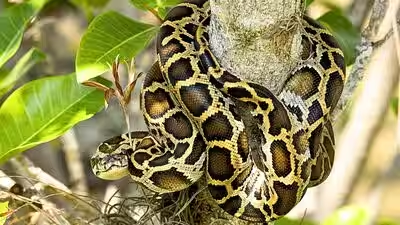
Researchers examined every body vertebra in 13 Australian snakes and found five distinct regions, including a short neck just 7 to 12 vertebrae long

Snakes aren’t simple tubes. Their bodies have five regions—including a short neck By measuring every vertebra along the bodies of 13 native Australian snakes, evolutionary biologists have discovered that a snake’s spine is much more organized than previously believed. Instead of being one long, uniform structure, it contains five distinct anatomical regions, including a surprisingly…

Read More