










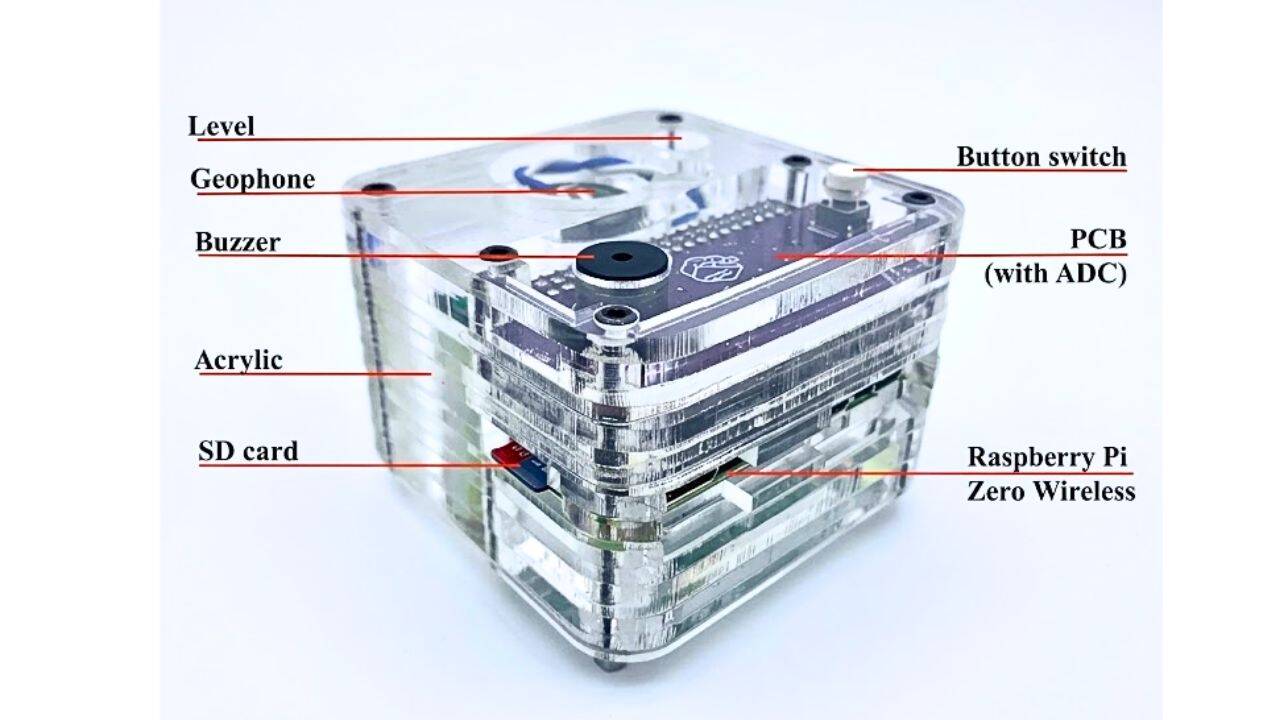
Earthquake warnings usually depend on networks of specialised instruments that detect ground motion and quickly identify an earthquake. Vivien He studied a different approach using a small and inexpensive device called Qube. The Internet of Things device cost less than $100 and was about the size of a Rubik’s cube. It used a geophone to detect ground motion and could provide warnings through an onboard alarm or text messages.According to the study published in Seismological Research Letters titled ‘Development of Qube: A Low‐Cost Internet of Things Device for On‐Site and Regional Earthquake Warning‘, the device detected all earthquakes above M 3.0 around Los Angeles and nearby earthquakes as small as M 2.3.
How Vivien He developed and tested the low-cost Qube earthquake detector
Vivien He developed Qube as an Internet of Things device for earthquake detection and early warning. The device cost less than $100 and was approximately the size of a Rubik’s cube. It used a geophone to sense ground-motion velocity and included Wi-Fi connectivity. He tested the device in the Los Angeles area for nine months, from September 2020 to May 2021. Qube could be controlled through a smartphone or computer and provided two forms of warning. Its onboard alarm was designed for on-site warning, while text messages were sent to local subscribers for regional warning. During the testing period, Qube detected all earthquakes over M 3.0 around Los Angeles and nearby earthquakes down to M 2.3. The study examined these recordings to evaluate the device’s earthquake detection capabilities.
PC: Seismological Research Letters
What makes Qube useful for detecting earthquakes and sending warnings
The Qube device detected earthquake ground motion through a geophone that measured ground-motion velocity. Its recordings produced earthquake waveforms that were consistent with those recorded by a nearby broadband seismometer in the Southern California Seismic Network. The device was connected to wi-fi, allowing earthquake information to be communicated through the system.When an earthquake was detected, Qube could activate its onboard alarm for people near the device. It could also send text messages to local subscribers for regional warning. The study describes this combination of earthquake sensing, connectivity, and warning as a consumer-based approach to earthquake early warning.
How accurately did Qube detect earthquakes during the test
One of the earthquakes detected during the testing period was a M 4.5 event on 19 September 2020. The earthquake had an epicentre about 40 km from the Qube test location. The device issued an earthquake early warning alert during the event. It also activated its onboard alarm and sent text messages to local subscribers.The seismic waveform recorded by Qube was consistent with the waveform recorded by a nearby official seismometer in the Southern California Seismic Network. During the nine-month testing period, Qube detected all earthquakes over M 3.0 around Los Angeles. It also detected nearby earthquakes down to M 2.3. These observations formed part of the study’s assessment of whether a low-cost consumer device could detect earthquake signals and provide warnings.
What did Qube recordings show about earthquake magnitude and ground motion
The earthquake records collected by Qube were also examined to study the relationship between ground-motion amplitude and local earthquake magnitude. For eight Los Angeles area earthquakes detected between September 2020 and May 2021, the study developed an empirical logarithmic formula connecting Qube’s ground-motion amplitude in digital counts with local earthquake magnitude.The study reported a linear relationship between earthquake magnitude and the logarithm of ground-motion amplitude, with R² = 0.9562. The paper also noted that Qube’s response in digital counts to ground-motion velocity in micrometres per second (μm/s) had not been determined. The empirical relationship provided a way to examine Qube measurements alongside local earthquake magnitude. The study presented the low-cost device as a consumer-based earthquake warning system that could be used in dense networks.