





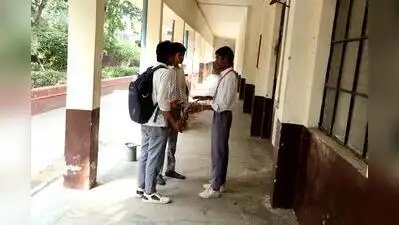
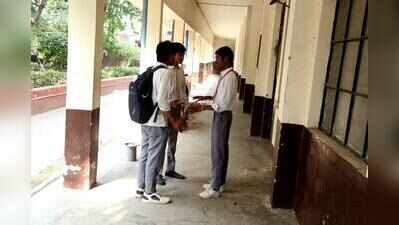
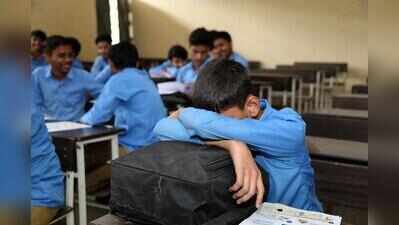
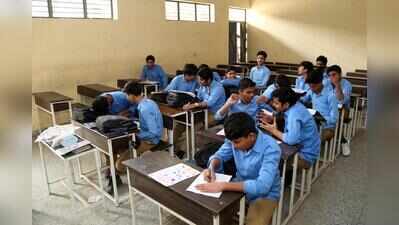
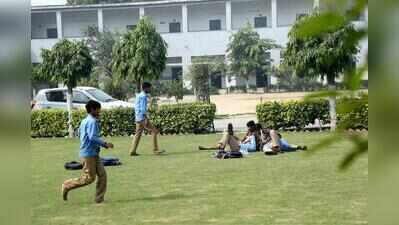
Ghaziabad: On Monday morning, the busiest part of Shambhu Dayal Inter College, one of the largest govt schools in Ghaziabad, was its playground. With consecutive free periods, most of its 2,548 enrolled students are left to their own devices.With voter enrolment drives beginning again in UP after controversial exclusions from the rolls during special intensive revision (SIR) earlier this year, 38 of its 42 teachers are absent because they have been assigned booth-level officer (BLO) duty.At Seth Mukund Lal Inter College, 34 of 36 teachers are on BLO duty, leaving 1,300 students similarly affected.Across govt schools, the picture is similar, even for students of classes IX to XII who will appear for pre-board tests in Dec-Jan and board exams in Feb, with practically no teaching taking place.The Shambhu Dayal campus doubles as a BLO training centre. These sessions have squeezed the space for academic activity further. With teachers remaining off campus for a large part of this year, first because of SIR, then for Census and now again for another round of voter enrolment under special summary revision (SSR), school authorities said syllabuses remain incomplete and time has virtually run out.“Private schools have started conducting revision classes, holding practice tests and preparing students for pre-board examinations. But thousands of students in govt and govt-aided schools are turning up every morning only to sit idle, play in corridors or return home by recess. As a teacher, it is disheartening to see that students’ education and future seem to be the govt’s last priority,” a senior teacher at a govt school in Ghaziabad told TOI.Special intensive revision (SIR) of electoral rolls involved the deployment of 1,868 booth-level officers (BLOs) in Gautam Budh Nagar and 3,224 in Ghaziabad for a total of 85 days across three phases — 32 days of door-to-door enumeration from Nov 4 to Dec 5, 38 days of special camps and hearings from Jan 21 to Feb 27, and 15 days of claims and objections from March 27 to April 10. For Special Summary Revision, a similar number of BLOs have been assigned duties for nearly 80 days, from Oct 17 until Jan 4, when the final electoral rolls are scheduled to be published.The Census 2027 exercise involved 9,000 officials in GB Nagar and 10,025 in Ghaziabad for 30 days of household listing from May 22 to June 20. They are to be deployed for another round of online data entry from Feb 1 next year.Under Section 13B(2) of the Representation of the People Act, 1950, BLOs are appointed from staff working in govt schools, offices and other local bodies. Data shared by district administrations show a total of 1,089 teachers in Noida and 2,025 in Ghaziabad were deployed as BLOs for the three rounds.So, for a typical academic calendar of 221 days (April 2026 to March 2027), excluding holidays and vacations, over 3,000 teachers were deployed on non-academic duties for around 102 days, including phased training and fieldwork.Earlier this month, TOI highlighted how staff shortage due to non-academic duty has affected learning in primary classes too. The report ‘Census, SIR duty pulls over half of primary teachers out of class in Noida, syllabus can wait’, published on Nov 2, showed how nine of the 11 teachers at Tuglapur Primary School near Pari Chowk in Greater Noida had been pulled out first for SIR and then for Census duties, leaving its 333 students struggling with basic concepts in all subjects. At Upper Primary School in Tuglapur, which has 369 students on the rolls, all its 10 teachers were assigned Census duties. All seven teachers at Jhatta Composite School and 13 at Gharbara Composite School were deployed for electoral roll revision and Census work.“There are hardly any laboratory or practical classes; almost over 50% of the science syllabus is left untouched, and preboards are in less than a month. If students are not studying in school for over two months, how will they even appear for the exam?” said a teacher at the school, who requested not to be named.Another secondary school teacher said the administration had exempted only those who were on medical leave or had physical disabilities. “If any teacher protests, then they are warned of action. The administration was requested to distribute the teacher work in such a way that classes are not hampered, but were told to prioritise Census duties,” the teacher shared.“Census and BLO duties are important government exercises that require extensive manpower and coordination. Teachers have traditionally been involved in such exercises because of their familiarity with local communities and their ability to carry out field-level responsibilities. However, we understand that academic activities must not suffer. While a significant number of teachers have been assigned these duties, at least a few teachers remain available in schools to manage classes and ensure that students are not left unattended. School authorities have also been asked to make internal arrangements to minimise disruption,” a senior district administration official said.‘No classes held, only attendance marked’Rekha, a parent of a Class VIII student at SD Intercollege, asked what the point was of sending children to school if there were no teachers. “My child leaves home every morning with his schoolbag and returns by afternoon only to say no classes were held. This has been going on for weeks. We send our children to school to learn, not simply to mark attendance and come back home,” she told TOI.Robin Kumar, whose daughter is in Class IX at Seth Mukund Lal Inter College, said the girl dreams of becoming a doctor. “We are from a poor family. I pull a rickshaw to make ends meet. We cannot afford private tuition or expensive coaching classes. Govt school is her only hope of getting an education and building a better future. But if teachers are not available and classes are not being held for months, how will she fulfil her dreams? We are doing everything we can to support her, but the govt is not doing its part. Why should children from poor families have to sacrifice their dreams?” he asked.