








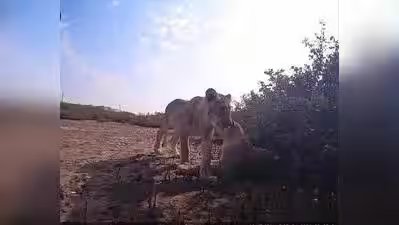
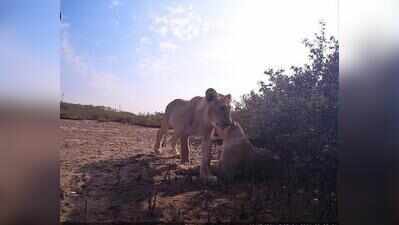
Ahmedabad: Gujarat’s coastal mangroves, long the preserve of crocodiles, migratory birds and marine life, have gained an unlikely new resident: the Asiatic lion. Researchers have photographed the big cats moving into and resting in these tidal forest patches — the first such record in India of lions using mangrove habitat.The study, “From Forest to Shore: Tracing the Asiatic Lion’s Journey into Mangrove Habitats,” was published as a short communication in Proceedings of the Zoological Society. Conducted between Jan and June 2024 by Vishal Patel, Khushboo Singla and Nishith Dharaiya, it used camera traps in coastal Amreli district, which returned 45 images of four lions — one adult female and three sub-adults — over 30 trap nights.The finding comes amid a 70% rise in Gujarat’s lion population over a decade, from 523 in 2015 to 891 in 2025. Several satellite populations have since established themselves outside the Gir Protected Area, many along the coast. Researchers attribute the spread to population growth and competition for space in traditional forest habitat.The mangrove ecosystem may suit dispersing lions for practical reasons. “Compared with farmland, these patches are relatively undisturbed, and the dense canopy offers shade through the fierce summer months,” Dharaiya said. “And the prey is already there.”The same camera traps recorded 43 images of golden jackals (Canis aureus) and 24 of wild pigs, along with pugmarks of jungle cats. Whether lions hunt in the mangroves is not established, but the presence of wild prey could make the patches viable stopovers or resting sites as the animals move along the coast.H S Singh, a wildlife expert, said lions usually keep away from mangroves, though they occasionally move into the mudflats when seeking cooler ground. “There have been a couple of such instances. The study, which has documented big cats’ presence in mangroves, merits a detailed study on the subject,” he said.The study draws a parallel with Namibia’s Skeleton Coast lions, which have adapted to shoreline life and have been reported feeding on Cape fur seals, cormorants and greater flamingos. An earlier study, published in Conservation, had flagged Gujarat’s coastline as part of the lions’ expanding range but had not documented them inside mangrove habitat. It found that nearly 70% of the biomass consumed by Gujarat’s coastal lions comes from wild prey.The researchers acknowledged the limitations of the latest study. “It covered a single season, ran 30 trap nights and documented four animals — too small a sample to estimate occupancy, abundance or encounter rates. No dietary analysis was attempted. We cannot yet say whether these lions are permanent residents, seasonal visitors or occasional users,” Dharaiya told TOI.“The sightings recorded in our study suggest that mangrove-fringed coastal areas are a potential habitat for lions in the future,” he said. “This coastal population is linked to Gir’s protected areas through small forest patches and agro-pastoral land. However, a detailed study is required — one that tracks lion movement and estimates the occupancy and abundance of both lions and their prey.”The team recommends GPS collaring, scat analysis and long-term camera trapping to map movement, feeding ecology and habitat use, alongside research into how lions interact with salt workers, livestock owners and other coastal communities.For all its limitations, the study matters because it identifies mangroves as a habitat that has drawn little attention in lion conservation planning. As Gujarat’s lions push further beyond Gir into farmland, scrub forest and coastal tracts, these ecosystems could become an increasingly significant part of the species’ future range — an argument for writing coastal habitats into a long-term conservation and management strategy.Mangroves are salt-tolerant trees and shrubs that grow in intertidal coastal areas, mainly in tropical and subtropical regions. They thrive where land and sea meet, often in brackish water, and act as a buffer against cyclones and coastal erosion. Gujarat holds the country’s second-highest mangrove cover, at about 1,164 sq km (23%), according to the latest report of Forest Survey of India.The mangrove patches in coastal Amreli cover 1.78 sq km and are dominated by Avicennia marina, the grey mangrove — the most widespread of India’s mangrove species and highly tolerant of salinity.