









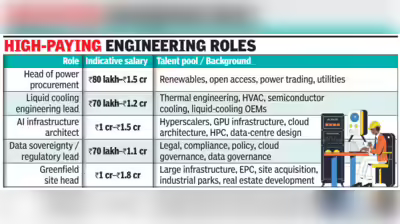
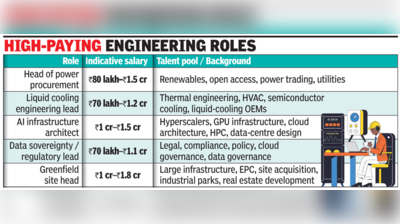
Bengaluru: India’s AI data-centre boom is creating an unexpected winner: engineers from mechanical, electrical and industrial backgrounds.As companies race to build energy-intensive AI infrastructure, mechanical, electrical and cooling engineers—roles long overshadowed by software jobs—are back in demand, commanding hefty salaries and opening a new career path for industrial talent.Companies actively hiring span the full AI infrastructure chain. They include colocation players such as Equinix, STT GDC India, Yotta, CtrlS and NTT; hyperscalers including AWS, Google and Microsoft; and engineering and cooling majors such as L&T, Tata Projects, Schneider Electric, Vertiv, Siemens, Honeywell and Johnson Controls. For India’s engineers, the AI boom is increasingly becoming a physical infrastructure story, driven by substations, cooling plants and power systems as much as by code.The hiring surge is being fuelled by the rapid expansion of India’s data-centre industry. According to Avendus Capital, operational data-centre capacity is expected to rise from 1.6 GW in 2025 to 5 GW by 2030. More than 3 GW of capacity is already under development, requiring nearly $25 billion in investments, while AI-specific capacity is expected to quadruple.Exclusive hiring data shared with TOI by executive search firm Ishwa Consulting shows specialised roles emerging across AI data centres, including AI infrastructure architects, liquid cooling specialists, power procurement heads and grid resilience managers.The salaries are eye-catching. AI infrastructure architects earn between Rs 1 crore and Rs 1.5 crore annually, while greenfield site heads can command up to Rs 1.8 crore. Heads of critical facilities and specialist cooling teams are making Rs 50 lakh to over Rs 1 crore a year. Engineers with seven to 12 years of experience are earning Rs 15 lakh to Rs 30 lakh, while entry-level cooling and critical-facility engineers start at Rs 5 lakh to Rs 8 lakh annually.The biggest hiring rush is happening in cooling. Companies are actively recruiting data-centre cooling engineers, HVAC design engineers, critical facilities engineers, commissioning engineers and liquid cooling specialists, while BMS and controls engineers are also seeing strong demand as facilities become increasingly automated.The newest and fastest-growing area is liquid cooling. Specialists work on direct-to-chip cooling systems, immersion tanks and coolant distribution units—technologies becoming essential as AI workloads drive up server density and heat generation.“Cooling engineering requires thermodynamics, fluid mechanics, and an understanding of mechanical and electrical systems at a facilities level,” said Mahesh Trivedi, EVP-DC Engineering at Neysa. AI campuses, he added, now also require expertise in stainless steel piping, coolant chemistry and advanced safety controls.The talent hunt is widening beyond traditional data-centre operators.Arvind Pandit, founder and managing partner at Ishwa Consulting, said AI infrastructure’s growing power and cooling requirements are pushing companies to hire from telecom, cloud, power, renewables, utilities, airports, metros, pharma and refineries. “The common thread isn’t the sector; it’s whether the person has worked in environments where uptime, load, safety and redundancy are non-negotiable,” he said.PSU and ex-PSU engineers from NTPC, Power Grid, BHEL, ONGC and Indian Oil are also being tapped, both as consultants and full-time hires, especially where deep power systems, grid and substation expertise are needed.Navnit Singh, chairman and regional managing director at executive search firm Korn Ferry India, said newer infrastructure sectors often rely on external expertise in their early years before local talent catches up. “That’s how industrial ecosystems evolve,” he said.The AI revolution is creating a new class of technology workers whose tools are not just algorithms and code, but also chillers, transformers, and cooling systems that keep the world’s AI engines running.