









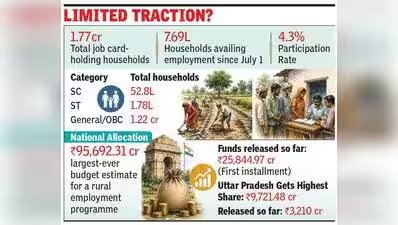
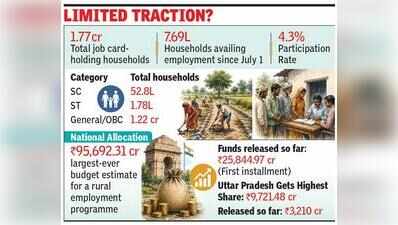
Lucknow: More than a month after its rollout, the Viksit Bharat – Guarantee for Rozgar and Ajeevika Mission (Gramin) (VB-G-RAM-G), aimed at boosting rural employment and livelihoods, appears to have generated limited traction among its intended beneficiaries.Rural development department data show that against more than 1.77 crore job card-holding households, only 7,68,550 have availed themselves of employment since Jul 1, when the scheme came into effect. This translates into just over 4% of the total beneficiaries.The slow start comes despite Centre’s strong push for the programme, projected as a major upgrade over the Mahatma Gandhi National Rural Employment Guarantee Scheme (MGNREGS), with a larger budget, 125 days of guaranteed employment, and greater emphasis on asset creation. However, the initial response has remained muted.Of the total 1.77 crore households provided with job cards, around 52.8 lakh belong to the Scheduled Caste category, while 1.78 lakh are tribal households. As many as 1.22 crore households belong to the general and OBC categories.The sluggish rollout has emerged as a challenge for the central govt, which projected VB-G-RAM-G as a flagship rural employment reform. Analysts said that if participation remains subdued over the next few months, critics may argue that the expanded guarantee of 125 days exists largely on paper, while govt may contend that the scheme is still in its infancy and needs time to stabilise.Notably, VB-G-RAM-G Act, 2025, provides a statutory framework for the timely and effective implementation of the scheme. The budgetary allocation of Rs 95,692.31 crore for the scheme in FY 2026-27 (for the period from Jul 1, 2026, to Mar 31, 2027) is among the largest allocations made at the budget estimate stage for any rural employment programme in the country’s history.Further, a normative allocation of Rs 95,692.31 crore has already been distributed among states and Union Territories, and first-instalment sanctions amounting to Rs 25,844.97 crore have been issued. UP has received the highest allocation at Rs 9,721.48 crore, of which Rs 3,210 crore has already been released as the first instalment.Congress functionary and former member of central council for MGNREGS, Sanjay Dixit said the scheme is yet to gain the desired traction because demand for work is not being properly registered. He also claimed that workers are not being paid on time, forcing many to look for alternative sources of employment.Analysts said the scheme was bound to face initial hiccups. “Rural workers may not yet be fully aware of the changes, highlighting the need for greater awareness,” said an official in the rural development department. Sources said local officials may be processing registrations and sanctioning works cautiously during the initial phase to avoid procedural errors under the new framework.