








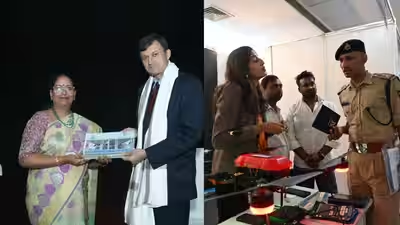
LUCKNOW: Emphasising the growing role of artificial intelligence in modern policing, ADG Technical Services Bhagwan Swarup Srivastava has called for greater integration of AI-based technologies into policing while stressing that technological systems must operate with human oversight and adequate safeguards.Addressing an event at the 3rd Police Technology Summit 2026 at Rashtriya Raksha University (RRU) at Atal Auditorium of DSMNRU, Lucknow, Srivastava said the biggest challenge facing modern policing was no longer capability but timing.He stressed that police forces must move beyond traditional reactive and predictive models towards a more advanced system of anticipatory policing.“Today, the challenge before modern policing is not of capability, but that of timing,” Srivastava said, underlining the need to move beyond conventional reactive and predictive approaches towards anticipatory policing.According to him, AI-enabled tools can help police identify patterns, analyse emerging threats and respond before an incident occurs.Srivastava cited international examples to underline both the potential and risks associated with AI-driven policing.He referred to London’s Metropolitan Police, saying it had been credited with making 962 arrests in a year based on live facial recognition powered by AI.However, he cautioned that the use of such technologies could also raise serious concerns if deployed without appropriate checks.Referring to the Los Angeles police department’s use of Palantir technology under Operation LASER, he said the programme faced criticism over allegations that individuals were targeted on the basis of association rather than evidence.“They were guilty by proximity, not by evidence,” he said while explaining the danger of relying excessively on technology without human assessment.He also referred to early crime hotspot prediction tools, including PredPol and Geolitica, saying such systems had delivered reductions in burglaries in parts of Los Angeles and Santa Cruz.However, he noted that these tools were also found to have concentrated police patrols disproportionately in low-income neighbourhoods, leading the LAPD to discontinue the programme in 2020.“These surely are not the reasons to avoid this technology,” Srivastava said, adding that such experiences instead demonstrated the need to incorporate human review and safeguards into AI-based policing systems.Srivastava said AI could enable police forces to “shift the response curve left” and evolve from merely reacting to incidents or predicting where crime might occur to anticipating potential threats before they materialise.He said RRU could become an important partner in the Uttar Pradesh Police’s efforts to develop anticipatory policing capabilities.“I see a lot of opportunity for cooperation and even a formal working partnership with RRU in various fields,” he said.The ADG outlined several areas where the university and police could collaborate, including AI-assisted pattern analytics and prediction, specialised training curricula, training field officers in modern AI-based tools, cyber-forensics and digital evidence.He said the scope of collaboration was extensive and could help bridge the gap between academic research and its practical application in policing.Srivastava particularly highlighted the importance of cyber-forensics and digital evidence in contemporary policing, referring to their significance under the new criminal justice framework.He said police personnel needed to be trained to effectively use emerging technologies and handle digital evidence as criminal activity increasingly moves into the cyber domain.The ADG also invited RRU vice-chancellor Dr Patel and campus director Dr Manjari to visit the technical and cyber wings of the Uttar Pradesh Police and interact with officers working on technology-driven policing initiatives.He said such a visit would provide the university leadership with an opportunity to see first-hand the transformation taking place in the police force’s technical and cyber wings.Srivastava said the journey towards anticipatory policing would have to be supported by technology capable of identifying threats before they turned into incidents.“The journey from predictive to anticipatory policing has to be backed by technology so that we can anticipate threats before they become incidents and build systems that make our citizens feel safe,” he said.He stressed that technology should ultimately serve the larger objective of citizen safety and effective crime prevention, rather than becoming an end in itself.“Our task is to make sure technology keeps pace with this commitment and that we continue to move from reactive or proactive towards anticipatory policing,” he said.He added that the approach was aligned with the broader vision of zero tolerance for crime and the welfare of every citizen.Srivastava concluded by saying that RRU’s mission and objectives were closely aligned with these goals and expressed confidence that greater cooperation between the university and the police would help advance technology-led policing.