








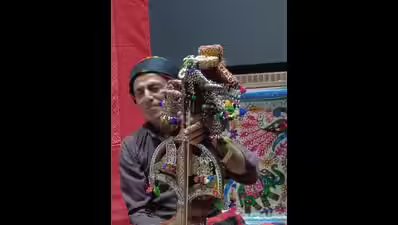
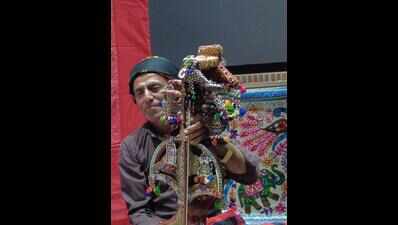
Ahmedabad: As dusk settles over the salt flats of Kutch, the roar of trucks gives way to a far older sound in Vagoth village near Naliya. Seated cross-legged with a weathered wooden instrument resting against his shoulder, 49-year-old Osman Jat draws a bow across eight strings and releases a haunting melody that has echoed across the desert for centuries.For most of the week, Osman drives heavy trucks along Gujarat’s highways to make ends meet. But on his days off, he becomes the custodian of a dying inheritance — perhaps the last great master of the Surando, a rare bowed chordophone whose voice once traveled freely between Kutch and Sindh.Beside him sits his nephew, 19-year-old Kasam, who travels 7km from a dairy in Sukhpar village whenever he can spare the time. Under Osman’s watchful eye, he practices finger placements and bowing techniques on an instrument that has survived invasions, migration, and partition — but may not survive modern indifference.“I want to pass this art on to someone before I die,” Osman says quietly during a recent visit to Ahmedabad for a stage performance. “Anyone who wants to learn seriously is welcome.”For Osman, the urgency is deeply personal. His family has played the Surando for generations, yet he fears the lineage may end with him. His son, like many young men in the region, has chosen the certainty of trucking over the uncertainty of folk music.“He drives trucks too,” Osman says with a faint smile. “He has no interest in music.”Osman’s Surando is believed to be around 150 years old. Before him, it belonged to his father Jat Sonu Savan, grandfather Savan Jat, and great-grandfather Mamad Jat.The story of how the family acquired the instrument has become folklore in itself.Before partition, a relative brought a Surando from Karachi to Kutch. Mamad Jat admired it intensely, but the owner refused to part with it. Determined to have one of his own, Mamad travelled to Bhavnagar, where artisan Hamir Jat crafted a Surando for him for Rs 3.That instrument still survives today in Osman’s hands — decorated lovingly with traditional embroidery and ornaments stitched by his daughters and nieces. “It is part of our family,” Osman says. “Not just an instrument.”Even India Post recognised the Surando’s cultural significance, issuing a commemorative stamp featuring it in 2020. Yet recognition has not translated into livelihood. “Maybe once every few months, I get a performance,” Osman says. “That is not enough to survive. So I drive trucks.”His recent Ahmedabad performance offered a glimpse of what preservation efforts could look like. The concert was organised by a collective led by Kaushal Bhatt along with collaborators Nidhi Joshi, Dhaval Hariyani, Smita Naidu, and Dhruvi Dave, all working to document and revive endangered folk traditions.The evening brought together several Kutchi folk artists — Mustafa Ali Jat performing traditional ‘beth’ vocal couplets, Ismail Mamad playing the jodiya pawa or double flute, and Hirabhai accompanying on ghado-ghamelo and ram-sagar percussion.For musician and folk arts documentarian Meet Dave, the Surando is far more than a regional instrument. “The Surando is a shared cultural bridge between Kutch and Sindh,” he says. “Recording and presenting these artists is vital. We need the world to hear them before they become museum exhibits.”That fear — of becoming a relic rather than a living tradition — looms heavily over Osman’s future.The economics of folk art remain brutally unforgiving. While audiences applaud on stage, artists often return home to financial insecurity. Osman says he would leave trucking instantly if traditional music could sustain him.“If this music could provide a proper income,” he says, “I would quit trucking without any hesitation.”What is Surando?The Surando itself carries the weight of history. Related to the Sarangi and Sarinda, its name comes from the Persian word ‘Surayindah’ (producer of tunes). Traditionally carved from a single block of wood, the instrument has a waisted body with a skin-covered belly and a hollow chamber that deepens its resonance. Three strings are played with the bow, accompanied by drone and sympathetic strings that create its layered, almost mournful sound.