










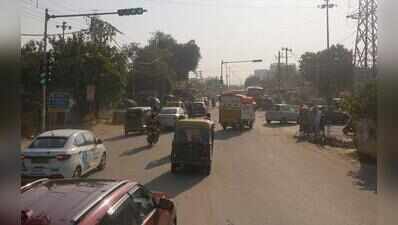
Gurgaon: Krishna Chowk will have a three-tier transport system under a revised plan, with a flyover set to replace the underpass.The busy junction — on the Bajghera-Old Gurgaon Road — is set to emerge as a major structure along the Gurgaon Metro corridor, as the planners are finalising a double-decker design instead of the originally proposed underpass. The surface road and the new flyover will cater to vehicular traffic, while the metro viaduct will run above the two levels.A GMRL (Gurgaon Metro Rail Limited) official told TOI, “GMRL shall construct the double-decker structure at Bajghera and Old Delhi Road integrated with the Metro viaduct and associated metro structure.” According to officials, the metro will run over a flyover from Bajghera Road towards Sheetla Mata Road via Krishna Chowk and from Sushil Aima Road towards Old Delhi Road. The flyover construction will cost around Rs 200 crore. In this regard, GMRL has requested Gurgaon Metropolitan Development Authority (GMDA) to provide Rs 100 crore at the earliest.Officials said the redesign is aimed at improving traffic movement and ensuring seamless integration of the metro with existing road infrastructure. The change, made due to space constraints, is expected to reduce construction complexity associated with an underpass while maintaining uninterrupted traffic flow at one of the city’s key intersections.GMRL is preparing to issue a tender under the second phase of the Old Gurgaon Metro (from Sector 9 to DLF Cyber City). “GMRL earlier planned to build underpasses at Krishna Chowk located on Palam Vihar Road and on Old Delhi Road. Due to the reduced width of these two roads, GMRL changed this plan,” said the officer.GMRL suggested that if a flyover is constructed in place of the underpass and the metro is operated over the flyover, then less land would be used. Because of this, vehicle drivers will not face any kind of difficulty in commuting. After receiving approval from GMDA, GMRL has now sought funds for its construction. GMRL has informed GMDA in this regard by writing a letter. In it, it has been said that the tender for the second phase of the Old Gurgaon Metro will be issued soon. In such a situation, this amount should be deposited.Earlier, the design was changed to construct the metro route over a flyover at Bakhtawar Chowk. GMDA earlier planned to build an underpass at this chowk, but when GMRL made a plan, it found the flyover appropriate. After the construction of the flyover and metro on a single pillar, a considerable area will be saved on the road for the movement of vehicles.At present, under the Old Gurgaon Metro, the work of construction of the metro station and route from Millennium City Center Metro Station to Sector 9 is underway. Under this plan, around 590 pillars have already been built. Construction work is currently progressing rapidly from Millennium City Center to Bakhtawar Chowk. In the second phase, a metro station and route are to be prepared from Sector 9 to DLF Cyber City, under which the process of issuing the tender is underway.Construction of the 28.5-km Gurgaon Metro corridor has gathered momentum, with work progressing across multiple locations despite challenges related to land acquisition, utility shifting and traffic management. The elevated corridor, connecting Millennium City Centre with Cyber City through 27 stations, is being executed in two phases by Gurugram Metro Rail Limited (GMRL).The first phase, covering the initial 15-km stretch from Millennium City Centre to Sector 9, has achieved around 8% civil progress. Foundation work, piling and pier construction are underway at several locations, while traffic diversions have been implemented to facilitate construction. Although land acquisition delays continue to affect work at a few critical stretches, officials remain confident of meeting the target. The first phase is scheduled for completion and commissioning by Aug 2028, providing the city with its first direct metro link through the old Gurugram areas.Preparations for the second phase, which will cover the remaining 14 km from Sector 9 to Cyber City, are also advancing. The tendering process was initiated during the first half of 2026, while preliminary site investigations, utility mapping and station planning are being carried out simultaneously. Major civil construction on this section is expected to gather pace once the first phase reaches peak construction later this year, allowing the project to progress without significant interruption.Once fully operational, the metro corridor will provide seamless connectivity between old and new Gurgaon, integrate with the existing Delhi Metro and Rapid Metro networks, and improve access to key residential, commercial and business districts. The project is expected to ease congestion on major arterial roads while offering a faster and more sustainable public transport option for daily commuters.