







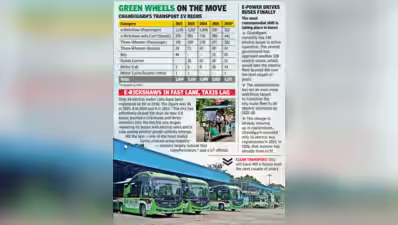
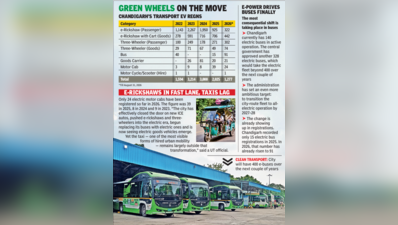
Chandigarh: Chandigarh’s electric-vehicle transition is no longer confined to private cars and scooters. It is beginning to reshape the public-transport system itself — from buses and passenger three-wheelers to the small goods carriers that move through the city’s markets.And the most revealing change may be taking place within the three-wheeler economy. The once-dominant passenger e-rickshaw is losing momentum, even as registrations of larger electric passenger three-wheelers continue to rise.The numbers suggest that Chandigarh’s electric transition is entering a second phase: not simply replacing petrol and diesel vehicles with electric ones but changing the mix of vehicles that make up the city’s public and commercial transport.So far in 2026, Chandigarh has registered 1,277 electric vehicles across public-transport and commercial-transport categories, according to registration data. Passenger and goods three-wheelers, e-rickshaws and buses account for the overwhelming majority. Only 24 motor cabs, or taxis, have been registered.The shift did not happen by accident.The Chandigarh administration effectively stopped registering new internal-combustion-engine auto-rickshaws — including CNG- and LPG-powered models — from 2021. The Chandigarh EV Policy, 2022, subsequently reinforced the push towards electric autos and other electric mobility.The result is now visible on the streets.FROM E-RICKSHAWS TO BIGGER THREE-WHEELERSIn 2023, Chandigarh registered 3,214 vehicles across these public and commercial transport categories. Passenger e-rickshaws accounted for 2,267 of them — roughly seven out of every 10.By 2025, passenger e-rickshaw registrations had fallen to 925.In 2026, they have fallen further to 322 so far.But this is not simply a story of electric three-wheelers losing steam.The larger passenger three-wheeler is moving in the opposite direction.Registrations rose from 100 in 2022 to 249 in 2023, 178 in 2024, 271 in 2025 and 302 in 2026 so far.The pattern hints at a subtle change in consumer and operator preference: the electric transition that began with the lightweight e-rickshaw may increasingly be moving towards higher-capacity three-wheelers.THE BUS IS FINALLY BECOMING ELECTRICThe most consequential shift, however, is taking place in buses.Chandigarh currently has 140 electric buses in active operation. The Central government has approved another 328 electric buses, which would take the electric fleet beyond 400 over the next couple of years.The administration has set an even more ambitious target: to transition the city-route fleet to all-electric operation by 2027–28.The change is already showing up in registrations. Chandigarh recorded only 15 electric bus registrations in 2025. In 2026, that number has already risen to 91.EVEN THE CARGO ECONOMY IS PLUGGING INThe electric transition is also spreading through the goods economy.Electric e-rickshaws fitted with carts recorded 442 registrations in 2026, after 706 in 2025 and 716 in 2024. The category had risen sharply from just 278 in 2022.Three-wheel goods carriers, meanwhile, have also been gaining ground, with registrations rising to 74 in 2026, compared with 49 in 2025 and 67 in 2024.Even larger goods carriers are beginning to enter the electric fleet: 21 were registered in 2026, compared with 20 in 2025.“It is a small number, but it points to an expansion of electrification beyond passenger mobility and into the less visible commercial traffic that keeps the city functioning,” said a UT official.The taxi paradoxThe conspicuous laggard is the taxi.Only 24 electric motor cabs have been registered so far in 2026. The figure was 39 in 2025, 8 in 2024 and 9 in 2023.“The city has effectively closed the door on new ICE autos, pushed e-rickshaws and three-wheelers into the electric era, begun replacing its buses with electric ones and is now seeing electric goods vehicles emerge. Yet the taxi — one of the most visible forms of hired urban mobility — remains largely outside that transformation,” said the official.BOX: transport EV registrations in Chandigarh…2026 (till August 31)Class | Counte-Rickshaw with Cart (G) | 442e-Rickshaw(P) | 322Three-Wheeler (Passenger) | 302Bus | 91Three-Wheeler (Goods) |74Motor Cab | 24Goods Carrier | 21Motor Cycle/Scooter-Used for Hire1Total | 1,2772025Class | Counte-Rickshaw(P) | 925e-Rickshaw with Cart (G) | 706Three-Wheeler (Passenger) | 271Three-Wheeler (Goods) | 49Motor Cab | 39Goods Carrier | 20Bus| 15Total | 2,0252024Class | Counte-Rickshaw(P) | 1,950e-Rickshaw with Cart (G) | 716Three-Wheeler (Passenger) | 178Goods Carrier | 81Three-Wheeler (Goods) | 67Motor Cab | 8Total | 3,0002023Class | Counte-Rickshaw(P)| 2,267e-Rickshaw with Cart (G) | 591Three-Wheeler (Passenger) | 249Three-Wheeler (Goods) | 71Goods Carrier | 26Motor Cab | 9Motor Cycle/Scooter-Used for Hire | 1Total | 3,2142022Class | Counte-Rickshaw(P) | 1,143e-Rickshaw with Cart (G) | 278Three-Wheeler (Passenger) | 100Bus | 40Three-Wheeler (Goods) | 29Motor Cab | 3Motor Cycle/Scooter-Used For Hire | 1Total | 1,594