









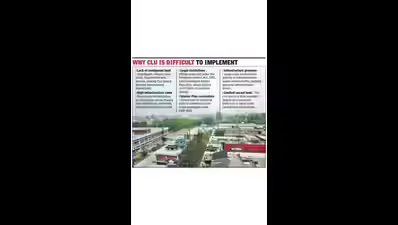
Chandigarh: Even as the Chandigarh administration pursues an ambitious reform agenda, a few long-pending demands — allowing conversion of industrial plots into retail commercial plots and permitting change of land use (CLU) in villages — are not part of the proposed reforms.“A consensus has developed within the administration that change of land use and conversion in the Industrial Area are not feasible at this point in time. Consequently, these issues are not being taken up as part of the reform agenda,” a senior UT official said.Officials said both demands are difficult to implement.“Chandigarh villages do not have large tracts of contiguous land to allow for CLU-based development. Cost-benefit analysis shows that infrastructure development on smaller land parcels would push land prices up, making projects financially unviable. In states where CLU is permitted, large contiguous land holdings are available. In Chandigarh, very limited vacant land exists for such development,” the official explained.The UT has about 22–23 villages (periphery and abadi areas such as Kajheri, Palsora, Raipur Kalan and others). These areas fall under the Periphery Control Act, 1952, and the Chandigarh Master Plan-2031. Traditionally, strict controls apply to the conversion of agricultural land for residential, commercial, industrial or farmhouse use.“Regarding conversion of industrial plots, it is against the provisions of the Chandigarh Master Plan-2031. There are also severe infrastructural constraints,” the official added.A long-standing demand in the Industrial Area has been to allow retail establishments to operate from industrial plots. Despite restrictions, hundreds of industrial plots — particularly in Industrial Area Phase-II — are currently being used as retail shops. Acting against such misuse, the Estate Office has issued hundreds of notices to these establishments.In 2005, a policy allowed conversion of industrial plots (minimum size of two kanals) into commercial use — including shops, offices, banks, hotels and restaurants — in Phases I and II. Around 82 to 125 plots were converted under the scheme, generating substantial revenue amounting to hundreds of crores for the administration. The permissible floor area ratio (FAR) for these plots was increased to 2.0, with a height limit of 30 metres.However, the Chandigarh Master Plan-2031 clearly states that the conversion policy will not be reintroduced. Industrial units are to be retained as industries due to problems arising from large-scale commercial activity, such as traffic congestion and parking shortages.Instead of permitting fresh conversions, the Chandigarh administration is focusing on increasing FAR for industrial plots in Phases I and II, allowing higher ground coverage, relaxing setbacks and building norms, permitting mixed land use in the undeveloped Industrial Area Phase-III, and implementing ease-of-doing-business reforms, including the possibility of leasehold-to-freehold conversion.Why CLU is difficult to implement—Lack of contiguous land: Chandigarh villages have small, fragmented land parcels, making CLU-based planned development impractical.—High infrastructure costs: Developing infrastructure on small plots would sharply raise land prices, rendering projects financially unviable —Legal restrictions: Village areas fall under the Periphery Control Act, 1952, and Chandigarh Master Plan-2031, which impose strict limits on land-use change —Master Plan constraints: Conversion of industrial plots to commercial use is not permitted under CMP-2031—Infrastructure pressure: Large-scale commercial activity in industrial areas would worsen traffic, parking and civic infrastructure stress —Limited vacant land: The city has very little available land to accommodate fresh CLU or large-scale commercial conversions