








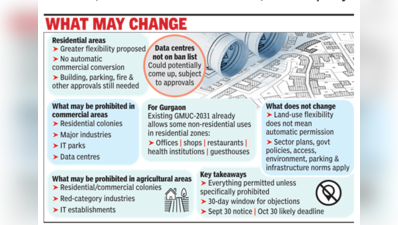
Gurgaon: A proposed change in Haryana’s land-use rules could alter how property owners, businesses and investors use land. Department of town and country planning (DTCP) is proposing to replace the existing “permitted-use” system with a list of prohibited activities, following the principle of “everything is permitted until prohibited”.Residential properties could see greater flexibility, while commercial zones would continue to exclude residential colonies, major industries, IT parks and data centres. In agricultural zones, residential and commercial colonies, red-category industries and IT establishments are proposed to remain prohibited, while data centres have been expressly excluded from the proposed prohibition.The proposal is not yet final. The department has invited objections and suggestions before the amendment is finalised. Govt will consider the proposed regulations after 30 days from publication of the Sept 30 notice, along with representations received from stakeholders. The move is part of Centre’s phase-2 compliance reduction and deregulation exercise and is aimed at allowing “demand-driven” uses across land-use zones, allowing construction approvals accordingly.A senior department official said, “The proposed amendment is at the public-notice stage and has been issued as part of the compliance-reduction and deregulation exercise. The department is inviting objections and suggestions and the final framework will be decided after considering the representations received. The proposed shift is from specifying permissible activities to identifying prohibited activities. It does not mean that every activity not appearing in the prohibited list will automatically be allowed, as prevailing policy parameters and other statutory requirements will continue to apply.”The proposal seeks to replace the existing practice of listing permissible activities in Appendix B with a list of prohibited activities for different major land-use zones. It also proposes deletion of Appendix A of the explanatory note of all published development plans. For a city homeowner, the change could be significant. Under the existing Gurgaon-Manesar Urban Complex-2031 framework, residential zones recognise uses beyond homes, including professional offices, retail shops, restaurants, health institutions and guest or boarding houses. However, these uses are subject to sector plans, govt policies and specific permissions.The proposed framework, therefore, does not simply mean that every activity can be undertaken anywhere. Instead, the draft specifically identifies activities that would remain prohibited. In residential zones, these include industrial units other than local service industries, industrial colonies, IT parks and IT units, data centres, logistics parks, warehouses and storage, wholesale establishments, transport nagars, goods terminals, STPs and waste-management facilities, among others. Dairy and poultry farming, mining, quarrying, stone crushing and hazardous trades are also proposed to remain prohibited.The proposed change extends beyond residential properties. In commercial zones, the draft proposes prohibiting residential colonies, industrial units and colonies, IT parks and IT units, data centres, logistics parks, waste-management facilities, agricultural and horticultural activities, dairy and poultry farming, mining and hazardous trades, among other uses.For agricultural landowners, the proposal could have particular significance. Residential and commercial colonies and red-category industries would remain prohibited, while IT establishments would also be prohibited except data centres. This explicit exception could make data centres a potential category for consideration on agricultural land, subject to other applicable approvals and infrastructure requirements.The draft also draws a relatively tight line around open spaces. It proposes prohibiting all activities other than parks, green belts, water bodies, sports-related activities, public utilities, fuel stations, public-transport infrastructure, recreational activities and crematoria/burial grounds.For residents, the larger question will be whether greater flexibility in land use brings more activity into established neighbourhoods and its implications for traffic, parking, noise, water supply and other civic infrastructure. For businesses and property owners, the proposed shift could reduce the uncertainty created when a proposed activity is simply absent from the existing permissible-use list.However, the proposed regime would retain significant govt discretion. Director of town and country planning could prohibit additional uses in public interest, while govt could also relax restrictions on activities in any zone under Section 7A of the 1963 Act.