






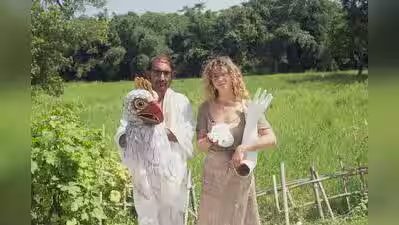
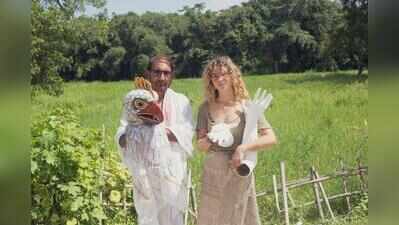
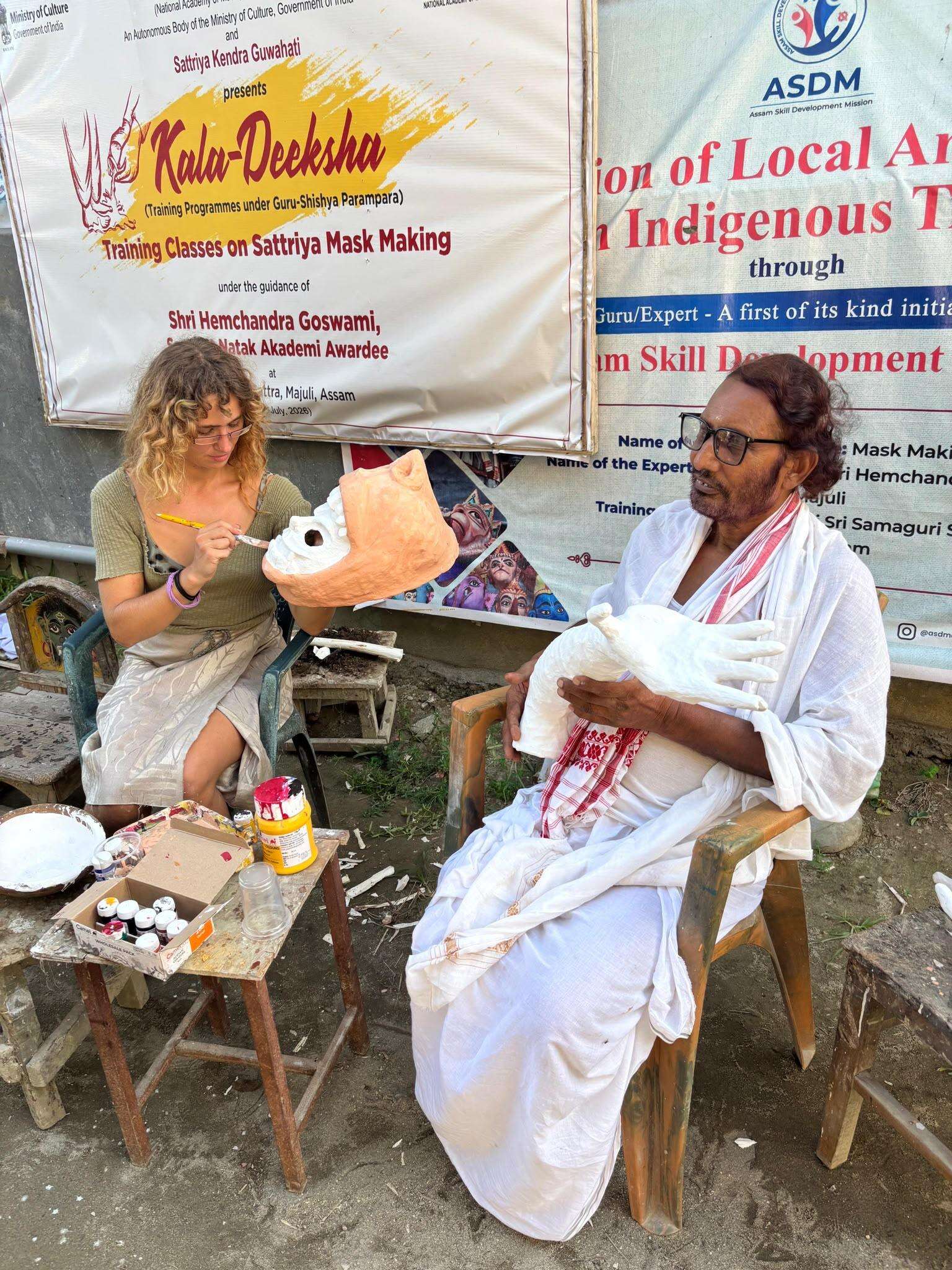
Guwahati: Dutch contemporary dancer and artist Leyla de Muynck has travelled to Majuli to learn the island’s traditional mask-making craft, or ‘Mukha Silpa’, rooted in the 16th-century neo-Vaishnavite movement led by Srimanta Sankardeva.The 33-year-old artist has been training since Sept 7 under Padma Shri awardee Hem Chandra Goswami at Samaguri Satra, a 363-year-old institution established in 1663 by Sri Sri Chakrapani, Sankardeva’s grandson.Leyla, who graduated in modern theatre dance from the Amsterdam University of the Arts in 2014, is in Assam as part of an art exchange project supported by the Embassy of the Netherlands in India.“I learnt about the tradition through the curators, who spearheaded the art exchange project, about half a year ago. One is a curator from the Netherlands, Bonne Reijn, and the other is from India, Farid Bawa. They created this project to connect artists and traditions from the two countries,” she told TOI.
Leyla de Muynck (Left) with Padma Shri Hem Chandra Goswami (Right)
She said the use of locally sourced materials made Majuli’s mask-making tradition unique.“What is really special about mask-making in Assam is that almost all the materials come from the area itself. Everything is collected from nature. Except for the paint, there is hardly anything that you need to go to a store and buy or bring in from somewhere else. The structure inside the mask is made from bamboo. The bamboo is sliced into small pieces or strings, which are then woven together. It is then covered with clay sourced from the river here. It is really fascinating. The artisans can simply go into the forest and to the river and source the materials they need. This makes the technique very special,” she said.During her training, Leyla made a mask with a wide mouth and a demon face inside, representing the darker side of one’s personality. She also created costumes with extra arms and ears to depict depression and anxiety, as well as a god-like figure combining human and bird forms.“We are going to spend the whole day filming while I perform in the costumes. I made the costumes around the idea that a mask can allow you to express something that you may not be able to express with your own face, or something that you may not dare to express. It can allow something hidden inside you to come out while your face is actually covered. There is a kind of paradox in that,” she said.Goswami said Leyla planned to use the mask in a dance performance. “She first painted the mask she wanted to make and approached me to prepare its base according to her concept,” he said.“She told me she was drawn to Majuli’s mask-making tradition. Though masks are made in different parts of the country, the tradition and the indigenous way of making them attracted her and brought her from the Netherlands,” Goswami added.Goswami was awarded the Padma Shri in 2023 for his contribution to the arts.Majuli’s mask-making tradition is closely associated with ‘Bhaona’, the neo-Vaishnavite theatre introduced by Sankardeva. Artisans use bamboo, cane, clay, cloth and natural colours to create masks depicting characters from mythological narratives.