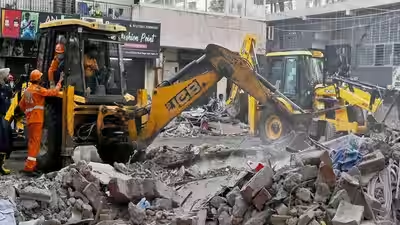









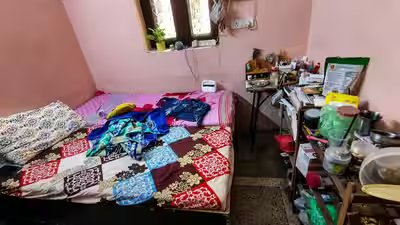
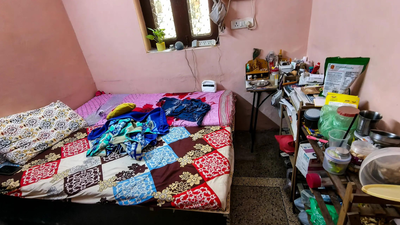
NEW DELHI: A bathroom in a balcony, a tin shed on the rooftop of a five-storey building without a lift, rooms where every inch counts and students paying extra even for a plastic study table.Students who come to Delhi to build their futures say they are “rotting” in spaces that feel more like prisons than homes, news agency PTI reported.The national capital is home to some of the country’s most sought-after educational institutions, but for many students, securing admission is only the beginning of their struggle.In Mukherjee Nagar and Kamla Nagar around North Campus, the IAS coaching hubs of Old Rajinder Nagar, Satya Niketan and Moti Bagh near South Campus, and the CA and CS coaching hub of Laxmi Nagar, students are living in cramped rooms and PGs, far removed from what they had imagined when they came to Delhi.Many endure these conditions to save money and reduce the financial burden on their parents.A PTI spot check across major student hubs in the capital, following the tragic death of seven students in the Satya Niketan building collapse, revealed the grim reality behind the city’s promise of top-tier education.In a Mukherjee Nagar PG, a room being prepared for the next batch had barely any space beyond a bed. A tiny sink and toilet pot had been placed in the balcony, PTI reported.“The bathroom could not be made inside because the space meant for it is occupied by a temple in the home of the family living on the floor below,” a broker said.Elsewhere, one room measured barely 6-7 ft by 4-5 ft, while another had a cardboard partition where a wall should have been.In rooms meant for two or three students, beds, racks, tables, books and clothes left little space to move.“An attached bathroom can cost you Rs 5,000 or Rs 6,000 more. So most of us compromise and take a room where one small bathroom is shared by two or three rooms,” a student living in Satya Niketan said.Rooms can cost Rs 6,000 without food and Rs 12,000-Rs 13,000 with food, while tiffin services cost another Rs 2,500 and electricity is charged separately.Students said old furniture and second-hand appliances add to the discomfort and sometimes increase electricity bills.Students also said they pay Rs 1,500-Rs 2,000 for an additional study table, sometimes receiving a plastic one.Speaking to PTI, Ritik, an IAS aspirant, said, “Imagine staying here for years for IAS coaching or university and having to pay separately for something as basic as a place to sit and study. When you add that to the rent, electricity charges and all the other extra costs, the amount becomes quite a lot for a student.”In Old Rajinder Nagar, students said brokers sometimes take advance payments promising to arrange rooms and then disappear.“My roommate lost Rs 10,000 to a broker. They ask for Rs 10,000 or Rs 12,000 as advance money, saying they will arrange a room, and then suddenly they disappear,” a student from Lucknow told PTI.“The worst part is that students are desperate. We have classes, exams and coaching to worry about, and brokers know that we don’t have much time to keep searching,” he said.Online listings can also present a different picture. A student in Moti Bagh said photographs often show clean, well-lit rooms that look very different when students arrive.“We see these places online and they look so nice in the pictures. You see a clean room, good lighting, a decent building and you think, okay, maybe this is where I can stay. But when you come here and you are desperate for a room, you don’t always have the luxury of walking away,” the student said.In Laxmi Nagar, a student preparing for CA and CS examinations said she has been living under a tin shed on the rooftop of a five-storey building since last year.“By afternoon, the room becomes so hot that the AC has to be switched on almost immediately. My electricity bill can reach Rs 5,000 a month in summer, even though much of my day is spent at coaching classes or the library,” she said.An ordinary rainy day can add to the inconvenience.“After rain, narrow lanes around the PGs can fill with stagnant water and mud, turning the route to college, coaching centres and libraries into a daily struggle. Inside, thin walls carry conversations from one room into another, leaving students with little privacy even when they shut their doors,” said another student.Safety concerns are particularly stark in buildings where commercial establishments operate below student accommodation.“Some of these hostels have sweet shops and chaat shops on the ground floor, and the cooking fire is running almost throughout the day. Above them, you have students living in extremely congested rooms. There are wires everywhere, narrow staircases, narrow corridors and basements that are not properly cleared. There aren’t proper entry and exit points,” a Bihar student preparing for IAS examinations said.“If a fire starts in one of these shops and catches onto the building, where are we supposed to go? There are so many people packed into these buildings that even one accident could put everyone at risk,” he added talking to PTI.For 19-year-old Akanksha, a student at Daulat Ram College, the danger came from an electric pole beside her PG. She said a spark in May lasted 10-12 minutes and set clothes hanging in the balcony on fire.For women, the concern extends beyond the building.An 18-year-old student in Satya Niketan said poorly lit, narrow lanes become particularly uncomfortable after dark.“At night, it becomes a completely different place. There isn’t enough lighting, and you don’t know who is standing around the corner. As a girl living here, you become very conscious of your surroundings the moment the sun goes down. You just want to reach your PG quickly and get inside,” the student said.Calling their rooms a refuge after hours of daily hustle, students said clean, affordable and safe housing was a basic right, particularly for those who would shape the country’s future.They urged authorities to address what they described as an “exploitative PG crisis” in the capital.(With ageny inputs)