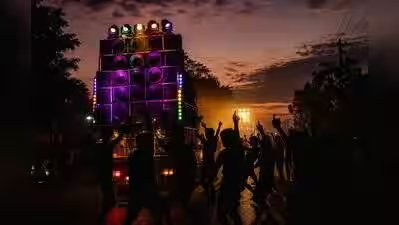









Pune: A 14-year-old boy from the city is reported to have suffered sudden hearing loss after sitting close to a loudspeaker during a recent procession. ENT (ear, nose, throat) specialist Dr Santosh Latkar told TOI that the boy, whose case he handled last week, developed what is known as ‘acoustic trauma’ after being exposed to very high-intensity sound for a short period.“The teenager was sitting on a tractor in front of the DJ when the exposure occurred. He subsequently became unable to hear, developed loud ringing in his ears and also had an episode of vomiting,” Latkar said.As festive season begins, city doctors are reporting more cases of hearing problems following exposure to loud sound systems, speakers and musical instruments like drums.Latkar explained that extremely loud sound can damage delicate hair cells in the inner ear that carry sound signals to the brain. “In case of the boy, the vomiting was likely linked to involvement of the balance (vestibular) nerve, which lies close to the hearing (cochlear) nerve and can cause giddiness and vomiting when affected,” he said.“The boy currently cannot hear anything,” the doctor said, adding that treatment has begun. According to him, some noise-induced hearing loss can recover when treated at an early stage, but ears can remain vulnerable, and repeated exposure to loud noise can turn the damage permanent.Latkar further cited another recent case of a 60-year-old man, who developed continuous ringing in his ears and irritability after exposure to loud sound in a procession. “The effects were not limited to hearing. The man also experienced a sudden rise in blood pressure and behavioural changes,” he said.Audiologist Dr Kalyani Mandke said, “I recently treated a 17-year-old girl, who developed ringing in her ear after practising dhol tasha. She subsequently reported the problem to a doctor and was found to have hearing loss in the right ear, while the left ear was unaffected at that point. Another 20-year-old who came to me last week had developed hearing loss in both ears while participating in a festive procession.”She said hearing loss is not always total, and can initially be as little as 5%, 10%, 20% or 30%. “Such people often do not report the problem immediately, particularly when the onset is gradual. Early warning signs can include low tolerance to loud sounds, headaches, dizziness, ringing in ears, irritability and difficulty focusing, but people often fail to link these symptoms to noise exposure,” she said, adding that prolonged exposure to noise can gradually affect the high-frequency range of hearing, which in turn affects speech clarity.A senior ENT specialist confirmed that doctors are seeing a rise in symptoms of impaired hearing among people exposed to loud sounds during processions and celebrations. “I recently had a case involving an 18-year-old boy, who stood on vehicles close to high-volume sound systems while dancing during processions, then developed hearing-related problems,” he said. As per his estimates, it may take two to three weeks to determine whether such hearing problems will reverse, making prevention particularly important.Dr Smitha Choutha also said she has recently seen several patients with sudden-onset tinnitus, or ringing or buzzing in the ears, following exposure to extremely loud festive sounds such as drums, loudspeakers and amplified music. She said tinnitus is a symptom rather than a disease and, in these cases, can be associated with noise-induced sensorineural hearing loss. A pure tone audiometry test can help diagnose the extent of hearing loss.“Sudden hearing loss following exposure to very loud noise should not be ignored,” Choutha said, stressing that early medical evaluation and prompt treatment, where indicated, are important because delays in some forms of sudden sensorineural hearing loss can reduce the chances of recovery and lead to permanent hearing impairment.