










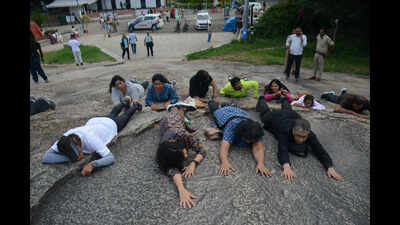
Jyotsna BasotiaOn Sunday mornings at Lalbagh, a small but growing crowd has gathered for the past three weeks. Children, retirees and walkers form a human chain, walk up to a rock and put their arms around it. The rock is Peninsular Gneiss, a geological formation inside Bengaluru’s oldest botanical garden that dates back more than 3.3 billion years. It has become the centrepiece of a campaign against the proposed Hebbal–Silk Board Tunnel Road, a roughly 17-km underground corridor intended to cut travel time between the city’s north and south.What happenedS Umesh Kumar, President of Lalbagh and Cubbon Park Walkers’ Association, says, “More than a hundred people joined demonstrations on August 2 and August 9. We are now planning a larger protest at Freedom Park, with up to 10,000 people, including students, environmentalists and celebrities like Sanjana Naidu and Sonika Gowda.”B V Sridhar Rao, who has walked in Lalbagh for over 30 years, is quick to point out that this isn’t the first time walkers have organised to protect Lalbagh. An earlier Metro proposal would have demolished part of the garden wall and felled nearly 400 trees, while a proposed multi-level parking complex would have taken up about five acres. Both plans were pushed back. “Every time, we’ve had to fight to keep the garden as it is,” says Sridhar, “Now it’s the rock.”Why the rock at Lalbagh matters“I was a boy when I started walking,” Sridhar fondly remembers, “I am not the first generation to walk at Lalbagh. My grandfather walked here, then my father, then myself, and now my daughter — that’s four generations.” Umesh, who lives less than a kilometre from the garden, puts it more simply: “We grew up playing here, in Lalbagh and in Cubbon Park.” “So many people come to Lalbagh to walk, run and jog for their physical health,” Suma B V, Organising Secretary at Lalbagh and Cubbon Park Walkers’ Association says, “It’s not that Bengaluru has no other parks. But this is the oldest one we have, going back to our earliest years. We’re asking the government to please set this project aside and think of another way.”What protesters fear: A cracked rock and a vanished lakeWalkers are particularly worried about vibrations from tunnelling or rock-cutting travelling through the ground near Lalbagh Lake. “The lake bed is a mud base, not concrete,” Sridhar says, adding, “Even a small capillary formed in the soil will be enough. Water will find its own way. As the water starts flowing, it can eventually become a big orifice in the underground. The lake will lose its water holding capacity.” Umesh adds, “If you go a hundred or two hundred feet under a rock formation like this, the whole thing gets damaged. Once that happens, you can’t undo it. Putting in steel supports afterward is no use. That’s just artificial.” A soil test conducted at the site has also angered the protesters. Sridhar argues, “When an appeal is pending, they should wait for the court’s direction before sending samples to the laboratory.”The bigger question: Does Bengaluru need this tunnel?The walkers insist they are not opposed to the tunnel project itself. “We are not against development,” Umesh says. “We are against the tunnel going under Lalbagh. That rock is our heritage. The route can be changed. Why does it have to pass under Lalbagh and Cubbon Park? These are the two eyes of Bengaluru.” Suma echoes the point. “We’ve been protesting for three weeks now to save the rock — it sits on six to eight acres, and the tunnel is meant to pass right beneath it,” she says, adding, “We are not against the project. We are against it passing through Lalbagh. The road runs all the way from Hebbal to Silk Board — there must be a way to build it that doesn’t cross the garden.” She also connects the fight to the city’s air quality. “COVID taught us how much we depend on clean air,” she says. “Where do we get that, if not from our parks? The city is already polluted enough.”What happens next in courtPIL petitions filed against the project, scheduled before the High Court for August 20, have now been adjourned to September 3. The walkers’ association is urging the government to reconsider the project. Umesh says, “Before the next hearing, we will discuss with all members how to take the initiative forward. We believe the court will give the right judgment.” Sridhar too remains hopeful the court will rule in the protesters’ favour once the scientific and technical arguments are heard.