









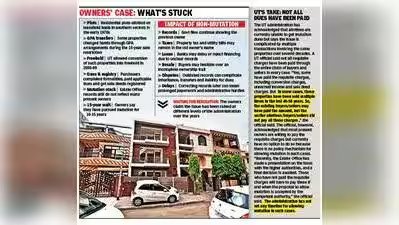

Chandigarh: Their sale deeds are registered, govt dues have been paid, and their plots have even been converted from leasehold to freehold. Yet, for scores of Chandigarh families, the most basic proof of ownership — the mutation of their properties in their names — remains stuck in the files of the UT estate office, in some cases for more than 15 years.The delay is not merely a paperwork problem. Owners say the absence of mutation is affecting their ability to raise loans, sell or transfer their properties and establish a clear ownership trail in official records. For elderly owners and families who have spent decades paying for and living in these properties, the uncertainty has turned what they believed was a completed ownership process into a prolonged bureaucratic limbo.The owners say the contradiction is hard to explain: the administration accepted the transactions, collected its dues, allowed freehold conversion and the Sub-Registrar registered the sale deeds—but the same administration has still not updated its ownership records.And while many other affected owners are ready to pay the requisite charges, they say they currently have no mechanism to do so and complete the mutation process.“We have been running from office to office for more than 15 years. The government has taken the money, registered the sale deeds and allowed freehold conversion, but when it comes to mutation, we are told there is a problem. How can the ownership be accepted for one purpose and rejected for another?” said an affected plot owner.The issue relates to residential plots allotted by the UT Administration in the early 1970s in several southern sectors. The plots were allotted on leasehold basis and carried a 15-year restriction on sale.During this period, some original allottees transferred their rights through General Power of Attorney (GPA) arrangements. Subsequently, in 2008-09, the UT Administration permitted conversion of such leasehold properties into freehold, including cases involving GPA holders.Following the policy, purchasers approached the authorities, completed the required formalities and paid applicable charges, including unearned profit to the Estate Office. Sale deeds were subsequently registered by the Sub-Registrar, Chandigarh, in favour of the purchasers/GPA holders.But the ownership trail stops there.Despite registration of the sale deeds and conversion of the properties into freehold, the owners say the Estate Office has continued to withhold mutation in their names.“The administration cannot have two positions on the same transaction. If the sale deed is good enough for registration and the government is willing to accept its dues and convert the property into freehold, there is no justification for keeping mutation pending indefinitely,” said another affected owner.Repeated assurances, no resolutionThe owners claim the issue has been raised at different levels of the administration over the years. They also approached grievance camps and say they were repeatedly assured that the matter would be resolved.“Every few years, we are asked to submit another representation or meet another officer. We have done everything possible. But the result is the same—no mutation,” said a resident.The owners now want the matter taken up at the highest level with the UT administrator and chief secretary and seek directions to the Estate Office to immediately mutate properties where freehold conversion and registered sale deeds have already been completed in favour of the present owners.“This is not a demand for a concession or a fresh policy. We only want the administration to update its records to reflect a transaction that it has itself permitted, registered and recognised,” said an affected owner.For families who have spent decades waiting for secure ownership of their homes, the question is now blunt: if the registry is valid, the govt has accepted its dues and the property is freehold, what exactly is stopping the administration from recording the owner’s name?BOX2: Owners’ case: What’s stuckPlots: Residential plots allotted on leasehold basis in southern sectors in the early 1970sGPA transfers: Some properties changed hands through GPA arrangements during the 15-year sale restriction.Freehold: UT allowed conversion of such properties into freehold in 2008-09.Dues & registry: Purchasers completed formalities, paid applicable dues and got sale deeds registered.Mutation stuck: Estate Office records still do not reflect many present owners.15-year wait: Owners say they have pursued mutation for 10-15 years.Box3: Impact of non-mutationRecords: Govt files continue showing the previous ownerTaxes: Property tax and utility bills may remain in the old owner’s nameLoans: Banks may delay or reject financing due to unclear recordsResale: Buyers may hesitate over an incomplete ownership trailDisputes: Outdated records can complicate inheritance, transfers and liability for duesDelays: Correcting records later can mean prolonged paperwork and administrative hurdlesBOX: UT’s take: ‘Not all dues have been paid’The UT administration has acknowledged that allottees are currently unable to get mutation done but says the issue is complicated by multiple transactions involving the same properties over several decades.A UT official said not all requisite charges have been paid through the entire chain of buyers and sellers in every case. “Yes, some have paid the requisite charges, including conversion charges, unearned income and sale deed charges. But in some cases, these properties have been sold multiple times in the last 40-50 years. So, the existing buyers/sellers may have paid the amount, but the earlier allottees/buyers/sellers did not pay all these charges,” the official said.The official, however, acknowledged that most present owners are willing to pay the requisite charges but currently have no option to do so because there is no policy mechanism for allowing mutation in such cases.The official said the issue arose following the Supreme Court judgment relating to property transactions involving GPA arrangements.“Recently, the Estate Office has made a presentation on the issue with the higher authorities, and a final decision is awaited. Those who have not paid the requisite charges will have to pay these if and when the proposal to allow mutation is accepted by the competent authority,” the official said.The administration has not set any timeline for allowing mutation in such cases.