








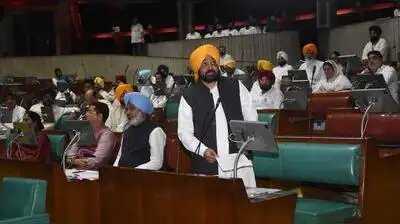
Chandigarh: The Punjab assembly on Monday unanimously passed Punjab State Outsourced Personnel (Transition to Contractual Engagement) Bill, 2026, paving the way for the transition of over 26,000 outsourced workers in govt departments and entities into direct contractual engagement after five years of continuous service. For workers in specified hazardous categories, the qualifying period has been reduced to three years.Winding up the discussion on the bill, chief minister Bhagwant Mann said the legislation would help end the exploitation of outsourced workers by eliminating the role of middlemen and establishing a direct contractual relationship between eligible employees and govt.Mann said govt had received numerous complaints regarding exploitation of outsourced workers by private agencies, including discrepancies between salary paid by govt and the amount actually received by employees. He said there were also complaints about workers being removed without notice and replaced with cheaper manpower.Emphasising the direct financial benefit to workers, Mann said, “The 15% to 22% commission currently charged by outsourcing agencies will no longer be deducted as an agency commission and the corresponding benefit will accrue to the employees.”Mann said, “Remuneration paid to employees will not be less than their existing salary or the legally prescribed minimum wages, whichever is applicable. They will receive the benefits of Provident Fund (PF) and gratuity, will be entitled to ESI benefits, will receive the benefit of maternity leave and, like regular employees, they will be entitled to 10 days of casual leave per year. Like regular employees, they will have an iHRMS account, ensuring greater transparency in their service records and employment.”Mann said the legislation would cover eligible Group-C and Group-D outsourced personnel engaged in essential public services and fulfilling the prescribed qualification and other conditions. He said workers in services such as electricity, fire and emergency response, sewerage and sanitation would benefit from the measure.The bill provides for direct year-on-year contractual engagement without the intervention of outsourcing agencies or middlemen. The eligibility conditions include deployment in essential public services, full-time and non-seasonal employment, a minimum of 240 days of actual attendance in each calendar year and at least seven hours of duty per day.The legislation makes it clear that the transition will not amount to permanent absorption or create a fresh cadre. Contractual engagement will be on a year-on-year basis, subject to satisfactory performance, and will not continue beyond the age of 58.The Act repeals Punjab Adhoc, Contractual, Daily Wage, Temporary, Work Charged and Outsourced Employees’ Welfare Act, 2016.Finance minister Harpal Singh Cheema, who introduced the bill, said, “Reliance on manpower supply agencies frequently exposed public utilities, healthcare continuity, and safety infrastructure to disruption risks caused by agency defaults. By cutting out intermediary agencies and establishing a direct master-servant relationship, the state ensures absolute transparency, uninterrupted public service delivery, and dignity of labour.”Speaking during the discussion on the bill, Dakha MLA Manpreet Singh Ayali said, “The govt should ensure that Punjabis are given preference on the basis of domicile and language. If a suitable Punjabi candidate is not available, only then should candidates from other states be considered.”