







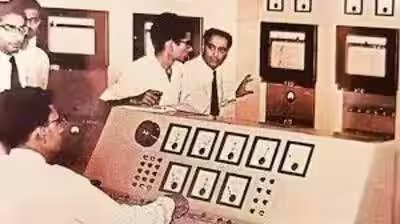
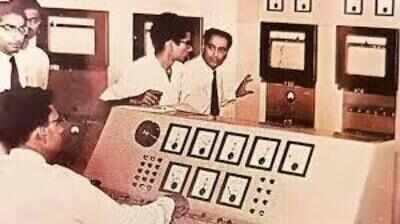
Mumbai: Saturday. Aug 4 1956. 3.45 p.m.Seventy years ago on this very day, as the monsoon was unleashing its full fury, India was rocketing into a new scientific era.It was India’s first nuclear reactor, Apsara —a pet project of Homi Bhabha—which attained criticality on that day at 3.45 p.m.In layman’s parlance, it means that this one mw reactor, which ushered in the atomic era not only in India, but also in Asia, had become operational. It was then formally inaugurated by Jawaharlal Nehru on January 20, 1957.Criticality in a nuclear reactor is attained when a self-sustaining fission chain reaction is achieved.The process begins when the reactor operators insert control rods. Then, at a certain point, these rods are withdrawn to initiate the process of starting the reactor.Former Indian nuke chief, R Chidambaram, recalled Nehru drawing a comparison between Elephanta Caves and Apsara. He remembered Nehru saying: “Both have their place and any person who ignores either of them misses an important element of life.’’The first attempt to make Apsara operational on July 31, 1956, failed due to technical reasons.In the second attempt on Aug 4, 1956, as the historic moment was nearing Raja Ramanna, the father of India’s nuclear weapon programme, who played a key role in the development of Apsara recalled in his autobiography, Years of Pilgrimage: “The event coincided with the heaviest monsoon in Mumbai. The roof was leaking, but so were the walls of the reactor hall.’’It was called a swimming pool reactor because, according to M R Srinivasan, former Indian nuclear chief, the core where the uranium chain reaction takes place is suspended in a pool of water.Six kg of enriched uranium fuel rods were imported from the UK.Bulk of the equipment, he said in his memoir, “From Fission To Fusion,’’ was obtained locally, with the New Standard Engineering Company at Chinchpokli, Mazagon Dock and TIFR playing a major part.Important visitors to Mumbai made it a point to visit Apsara, which included Chinese premier Chou-a-lai, Emperor Haile Selassie of Ethiopia and the Dalai Lama and Panchen Lama.The role of the reactor was multipurpose—training scientists, doing experiments in what is known as neutron physics, the production of radioisotopes and studies in shielding of nuclear radiation.TOI spoke to two officials who worked in Apsara.Anil Anand, former director of BARC’s reactor projects group, recalled it was a rewarding experience doing experiments at Apsara as it helped in developing future projects.Mohan Phadnis, scientific officer, explained the significance of Apsara, saying that it marked the first step in India’s journey into the nuclear domain.A.C. Tikku, former director of the reactor group when Apsara was taking shape, has been quoted as saying that the commissioning of Apsara laid the necessary infrastructure for nuclear research in basic and applied sciences and isotope production.’’It was decommissioned in 2009, but almost a decade later upgraded and recommissioned in Sept 10, 2018.