









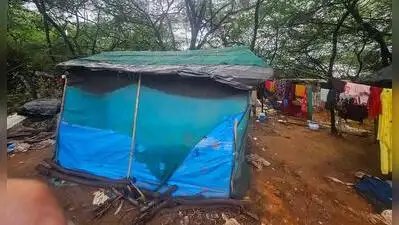
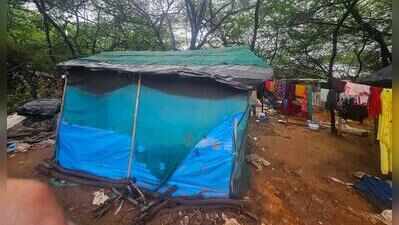
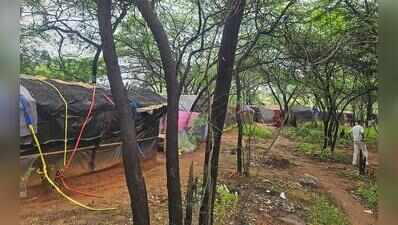
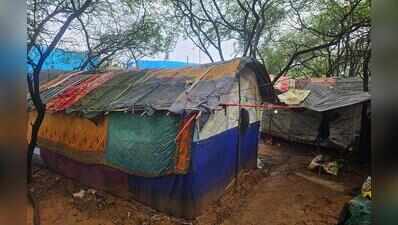
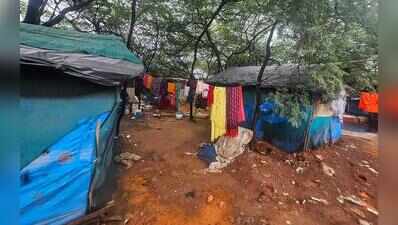
Gurgaon: Dozens of temporary structures have come up inside Mangar Bani buffer zone, in an area covered by sections 4 and 5 of Punjab Land Preservation Act (PLPA).Around two acres of land in the Aravalis — in Mangar — have been encroached upon by a sprawling settlement of makeshift hutments.Mangar Bani — a sacred grove near Mangar village — and its surrounding buffer are among the most ecologically sensitive Aravali patches in the city-Faridabad landscape.A ground visit found a sizeable cluster of shelters made of tarpaulin sheets, plastic, cloth, bamboo and other temporary material spread beneath the dense tree canopy.Several structures have been tied directly to trees, with ropes, pipes and sheets being used to create walls and roofs.The location of the settlement is significant because the recent road work and the newly detected jhuggi settlement indicate two different forms of human intervention in the same protected landscape: access infrastructure on the one hand and habitation on the other.The developments raise questions over when the settlement began, how around two acres came to be occupied and whether the authorities detected its expansion in time.They also raise concerns over whether improved access to the area could facilitate further occupation or other activities in the ecologically sensitive landscape.Faridabad divisional forest officer Jhalkar Uyake told TOI, “We have given them three days’ time to vacate the land, or else we will take action.”The area has been designated as a no-construction zone, while the land is also subject to PLPA restrictions that prohibit or regulate non-forest activities.The development comes weeks after TOI reported fresh road work inside Mangar Bani landscape, highlighting continuing pressure on an area where construction and changes in land use are restricted.In that case, a roughly 1-km internal pathway in the Mangar Bani area had been paved with interlocking blocks.The forest department had stopped the work and removed labourers from the site on July 18.Fresh paver blocks were subsequently found stocked at the location, raising concerns that work could resume.The latest ground visit shows another form of pressure on the same landscape, with a sizeable habitation spread across around two acres beneath the forest canopy.The ground situation is not of a few isolated temporary shelters.Multiple rows of hutments have spread through the wooded patch, with clotheslines, household articles, containers and other signs of regular habitation visible across the settlement.Several shelters have been constructed around existing trees, while tree trunks and branches have been used as supports.The ground around the structures has been cleared and compacted at several places, with plastic and other waste visible within the settlement.Mangar Bani has been the subject of protection measures for more than a decade.In 2014, National Green Tribunal directed Haryana govt to take steps towards protecting the Mangar Bani area, while NCR Planning Board decided that Mangar Bani and an essential 500-metre buffer should be treated as a no-construction zone.The board’s decision was subsequently incorporated into Haryana’s planning framework.In 2016, Haryana demarcated Mangar Bani as a forest area of around 677 acres and its 500-metre buffer of about 1,267 acres, bringing the combined protected/no-construction landscape to nearly 1,944 acres. Govt notified the area as a no-construction zone.Earlier forest department action in the area has treated construction and other non-forest activities as violations of the restrictions applicable to the notified land.The latest encroachment therefore comes at a time when authorities are already grappling with attempts to alter the landscape through roads, construction and other forms of intervention.Mangar Bani is considered a high-biodiversity zone and is among the few relatively undisturbed natural forest patches remaining in the NCR. It has around 30 native Aravali tree species, besides a rich diversity of shrubs, herbs and bird species.The forest also forms an important wildlife corridor and plays a role in groundwater recharge.