






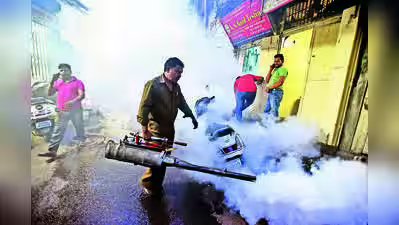
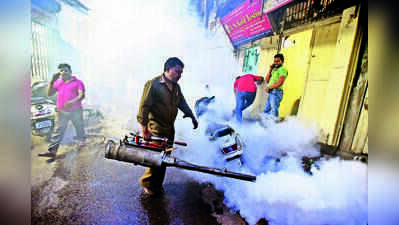
Gurgaon: Panchkula has overtaken the city even as Haryana’s dengue tally touched 614 cases by Oct 12 — rising by 22.1% in seven days. Panchkula has become the worst-affected district, topping the list with 77 cases, followed by the city with 71, Jhajjar with 55 and Rewari with 50, according to the state health department’s latest vector-borne disease bulletin.Faridabad reported 49 cases, Sonipat 47, Karnal 38, Rohtak 35 and Panipat 34. The state recorded 111 additional cases between the Oct 4 tally of 503 and Oct 12, when 21 new infections were reported in a single day. No dengue deaths have been reported in Haryana so far this year. The state’s district-wise data showed that govt hospitals had reported 365 of Haryana’s 614 cases, while private hospitals accounted for 249. In the city, 23 cases were reported by govt hospitals and 47 by private hospitals. Of the 21 new cases reported across Haryana on Oct 12, nine were reported by govt hospitals and 12 by private hospitals. The bulletin also recorded 12 new hospital admissions that day, including three in govt hospitals and nine in private facilities.Haryana has 27 functional dengue testing laboratories, with at least one in every district. Blood sampling has also been started at community health centres and primary health centres, with a focus on high-risk areas.CEO and chief of pathology at City Imaging & Clinical Labs (Delhi) Dr Sunita Kapoor told TOI, “With dengue symptoms often overlapping with those of other seasonal infections, timely testing is important to confirm the infection and identify patients who may need closer monitoring. Tests such as NS1 antigen or molecular testing may be recommended during the early phase, while IgM antibody testing can help detect infection at a later stage. A complete blood count is also used to monitor platelet levels and haematocrit. “Although imaging is not routinely required to diagnose dengue, ultrasound and chest imaging may be advised for patients with warning signs or suspected complications to detect fluid accumulation in the abdomen or around the lungs. Persistent vomiting, severe abdominal pain, bleeding or breathing difficulty require immediate medical attention, she said. Kapoor advised people to use mosquito repellents, wear full-sleeved clothing and eliminate stagnant water around their homes. People with suspected dengue should avoid self-medication, particularly aspirin and ibuprofen, as these medicines can increase the risk of bleeding.The department has urged residents to observe every Sunday as a ‘Drying Day’ by emptying and cleaning coolers, overhead water tanks, flower pots, refrigerator trays and other containers that can collect stagnant water. Residents have also been advised to cover water-storage containers and consult a doctor if they develop a fever. Private hospitals and laboratories have been directed to charge a maximum of Rs 600 for the recommended ELISA-based NS1/IgM dengue test. The state has also made provision for free single-donor platelets for Haryana residents with dengue admitted to govt hospitals, subject to the applicable provisions.The health department said 3 crore house visits had been conducted across Haryana up to Sept 30 to identify and eliminate mosquito-breeding sites. Mosquito larvae were found in 1.12 lakh houses during these visits. Fogging had been carried out in 4,983 localities across the state by Sept 30. The department had also issued 53,051 notices to premises where mosquito breeding was detected. According to the bulletin, the state had 4,435 hand-operated fogging machines and 33 vehicle-mounted machines. Gambusia fish, which feed on mosquito larvae, had been introduced in identified water bodies as another control measure. Of the 9,570 water bodies identified, 8,414 had been seeded with the fish.Despite the recent increase, Haryana’s cumulative dengue count remains below the annual totals recorded over the past five years. The state reported 11,837 cases in 2021, 8,996 in 2022, 8,083 in 2023, 6,469 in 2024 and 2,626 in 2025, according to the health department bulletin. The 614 cases recorded so far in 2026 are lower than the full-year total of 2,626 in 2025. However, the figures cover different periods, and the final tally for 2026 is not yet available.The city’s cumulative count increased from 60 on Sept 13 to 63 on Sept 30, 65 by Oct 4 and 70 by Oct 12. It added seven cases in the week after Oct 4, while Panchkula reported 19 additional cases over the same period. The latest figures mark a change in the district rankings. The Oct 5 report, based on data till Oct 4, had recorded 65 cases in the city and 58 in Panchkula. Jhajjar had reported 50 cases and Rewari 45 at the time. By Oct 12, Panchkula’s tally had risen to 77, against Gurgaon’s 71.As of Oct 12, 28 dengue patients remained admitted to hospitals across the state, including 10 in govt hospitals and 18 in private facilities. A total of 273 admitted patients had been discharged, while 313 patients had been treated in outpatient departments without requiring hospitalisation. The department collected 1,325 samples for dengue testing on Oct 12, taking the cumulative number of samples collected this year to 87,510.