









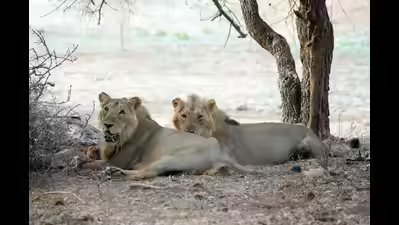
Ahmedabad: Amid fears that the twin attack of canine distemper virus (CDV) and babesiosis may have caused 13 lion deaths recently, an animal husbandry department survey has revealed that feral dogs outnumber cattle in the main lion cluster of Saurashtra.Amreli, Junagadh, Gir-Somnath, and Bhavnagar are the Saurashtra districts that support 95% of the Asiatic lion population, but troublingly, are also home to 1.08 lakh feral dogs — the potential carriers of the lion-endangering CDV.The same lion territories have about 80,050 stray cattle, often abandoned due to age or low productivity. These cattle are known to harbour ticks that spread babesiosis, another threat to lions.H S Singh, a former member of the National Board for Wildlife, said the latest data collected from the govt of India’s animal husbandry department livestock survey reveals that the four districts supporting 95% of the lion population also have 22.9 lakh domestic cattle.“There are about 84,460 ungulates in areas outside protected forests. There are no feral dogs or cattle within the Gir Sanctuary,” Singh said.The govt’s management plan must address the presence of nearly 1.9 lakh feral animals in the lion landscape, Singh said. He said these animals could pose a significant challenge to disease management efforts.Experts from the Wildlife Institute of India (WII) said it is well established that free-ranging dogs pose a threat of CDV transmission. A research paper titled ‘Canine Distemper Virus in Asiatic Lions of Gujarat State, India’, published after the 2018 CDV outbreak, noted that “canine distemper is prevalent among dogs in India, and the free-ranging dog population often poses a threat of CDV transmission to wildlife.”The paper added, “Other wildlife species also could play a role in maintenance and transmission of CDV.”Experts added that ticks are more commonly found on feral cattle, making the combined population of nearly 1.9 lakh feral dogs and cattle in these four districts a matter of concern for lion conservation.“At a time when the state is aiming to establish lion presence across all 11 districts of Saurashtra, it has to address the challenge posed by the 3.07 lakh feral dogs in the region as a whole, and the large population of feral cattle,” said a senior forest department officer.The officer noted that while tick-borne babesiosis infections are periodically reported in the Gir ecosystem, mortality can rise sharply when lions weakened by the parasitic infection are also exposed to CDV.Another senior forest department officer said disease surveillance must become an integral part of lion conservation planning. “As lions expand their territories into human-dominated landscapes, managing the population of feral dogs and abandoned cattle becomes critical.”The officer added, “The conservation challenge is no longer only about protecting lions; it is also about protecting them from diseases circulating in the environment.”With lion numbers at a historic high and their range continuing to expand, experts said that proactive disease surveillance and management could prove just as important as habitat protection in securing the future of the world’s last wild population of Asiatic lions.