








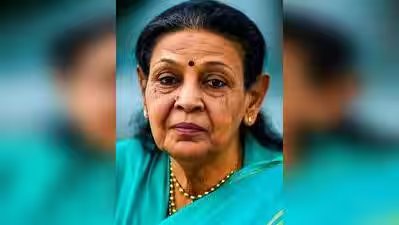
Chennai: There is a particular kind of song that Tamil cinema of the 1950s and 60s could not do without — the one sung by the friend, the maid, the courtesan, the child, the comedienne, the woman on the swing at the temple festival. Not the heroine’s tragic solo, but the number that made the theatre sit up and grin. For nearly two decades, that song more often than not belonged to K Jamuna Rani.She died on Thursday, July 30, in Bengaluru, of age-related ailments at 88. Her last rites were performed in the city the same day. With her goes one of the last direct links to the era of G Ramanathan, K V Mahadevan and the young Viswanathan–Ramamoorthy — a singer who recorded more than 6,000 songs in Telugu, Tamil, Kannada, Malayalam and Sinhala, and who had already been a professional for six years by the time she was 13.Born in Andhra Pradesh on May 17, 1938, to K Varadarajulu and violinist K Droupathy, she grew up inside music rather than beside it. Her mother’s training put her in front of a recording horn at seven, for the Telugu classic ‘Tyagayya’ (1946), composed by Chittoor V Nagaiah. By 1952 she had crossed into Tamil, and the crossing was emphatic: ‘Kalyani’ gave her ‘Success Success’, a song whose sheer cheek made her a name overnight, and ‘Valaiyapathi’, made at Modern Theatres, paired her with a then-rising T M Soundararajan.A year later came a small landmark that is rarely credited to her. In ‘Devadas’ (1953), she sang ‘O Devadhaas’ for a child on screen — one of the earliest instances of a playback voice being used for a child character in Tamil cinema, at a time when the convention was barely a decade old. In the same year, ‘Chandirani’ had her performing a duet largely composed of the word ‘meow’.That range — from a cat’s mewling to the plaintive — is the point. In an era when P Suseela held the heroine’s voice and Jikki the sparkle, Jamuna Rani was handed everything else, and made a career out of what other singers were not asked to do.Veterans recall a detail worth preserving: for a singer identified so completely with the thullal number, she never performed the accompanying dance, neither at recordings nor on stage. The energy was entirely in the throat.Less known in Chennai is that Jamuna Rani is, in Sri Lanka, a household voice. She first sang in Sinhala for ‘Sujatha’ (1953) under Ananda Samarakoon, the composer of that country’s national anthem, and went on to record for ‘Warada Kageda’, ‘Seda Sulang’, ‘Mathalan’, ‘Suraya’ and ‘Vana Mohini’. ‘Jeevana Mea Gamana Sansare’, her duet with A M Rajah from ‘Seda Sulang’, remains one of the most-loved songs in Sinhala cinema — an Indian singer’s voice sitting permanently inside another nation’s musical memory.Work thinned in the early 1970s as the industry’s sound changed. Then, in 1987, Ilaiyaraaja and Mani Ratnam went looking for a voice that carried the grain of old Madras, and found her. ‘Naan Sirithaal Deepavali’ in ‘Nayakan’ — sung with M S Rajeswari, and as ‘Naa Navve Deepavali’ in the Telugu ‘Nayakudu’ — introduced her to an audience that had not been born when she recorded ‘Success Success’. She sang once more in Tamil, in ‘Annan Ennada Thambi Ennada’ (1992), alongside Jikki. Two late Telugu appearances followed: ‘Varudu’ (2010) and ‘Mithunam’ (2012), recorded when she was 74.