









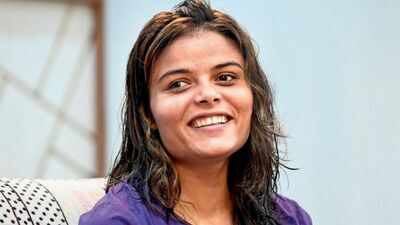
Simran Sharma was born extremely pre-term — at six-and-a-half months — grossly underweight and feeble. Doctors said her chances of survival were slim. Relatives said, “It’s okay, it’s only a girl,” she was told later. But the baby lived, somehow.That early trait of beating crushing odds is a recurring and defining feature of Simran’s life. Last month, the 27-year-old sprinted to a rare golden double (with her guide runner Shivam) in 100m and 200m at Asian Para Games in Aichi-Nagoya, Japan.Para-athletes are classified according to levels of impairment. Her category, T12, is for athletes whose vision is limited to a radius of less than 5 degrees. “Nothing”, she says, “has come easily to me in life.”Childhood was hard for Simran, who was born in Modinagar, about 50km north-east of Delhi. Her father was bedbound for years. Her mother cooked and cleaned hostels to put food on the table. “She would make sanitary pads and take a train to Delhi to sell them,” the para-athlete recalls. Yet, affection was abundant at home. “Maybe because parents shower more attention on the weaker child,” she says.Simran realised early she had speed. “In Class VI, I ran in a salwar-suit in a village sports meet and won a bunch of medals,” she remembers. But when she started training with a couple of other girls at the local MM College ground, social roadblocks emerged. Relatives and neighbours warned her family that practising with boys might lead the young girl astray. But her parents refused to back down. “They supported me all along,” Simran says, with gratitude and pride.Two incidents further steeled her. In Class X, a teacher slapped Simran in front of other students, mistaking her for another girl. “I felt she hit me because I had failed to win a medal. I practised hard and won a clutch of medals the next time.” Also embossed in her memory is the sight of her mother crying and pleading before the principal, who had once refused to send her for an inter-school meet.Till 18, Simran ran in open events. Due to her restrictive visual condition, she would occasionally stray into a neighbouring lane, leading to small fights. But she kept winning races.Yet, early success couldn’t spur her to dream big. “Poor kids often lack confidence. I just wanted to win at the state level. I hoped to become a physical instructor at school. Sapne seemit thhey (My dreams were limited),” she says.In 2015, she met Gajendra Singh, an Army serviceman from Khanjarpur, a village 3km from Modinagar. He would train in the same ground, sometimes dragging a tyre behind. “We would laugh. But he would offer help, motivate us,” she says. Slowly, they became friends.“We spoke on the phone, exchanged messages. Sau messages milte tthey (I would get a 100 messages),” she laughs. They got married in 2017.Gajendra was confident of her shining on bigger platforms. He sold a 100-yard plot of family land in Modinagar, invested in her special diet, shoes and sportswear. But the timings didn’t improve. “One day Gajju asked my coach, ‘Why isn’t she progressing?’ He replied in anger, ‘If you can make her run faster, go ahead.’ Gajju felt bad. He took it up as a challenge,” feels Simran.The jawan would take two months’ leave, read up articles on sprint, take online courses and create a training regimen that was “insane”. “Sometimes, I felt like fainting. I would hide. I would lie, pretend I had a headache. He would prepare a diet chart. I would throw it away. But he would just say, ‘You think I am your enemy now. But the day you win the medal, you will love me the most’,” laughs Simran, who idolises Cuban sprint legend Omara Durand.2019 was a dark year. “My father, who passed away in 2020, was on a ventilator. I was injured. My husband was in debt. He would be taunted for wasting his time on me. I was under extreme stress. I wrote a letter in blood saying sorry because I wasn’t able to do anything for him,” she confesses.But Gajendra hauled her back from the abyss. “He told me, ‘Girta kaun nahi hai. Tum girogi main tumhe uthaunga. Tum phir girogi, main phir uthaunga. Par main tumhe haarne nahi doonga (Everyone falls down. Every time you fall, I will lift you. I will not let you lose)’,” she says.The tide began to turn when she became part of Olympic Gold Quest, an NGO that supports athletes, in 2020. Simran became aware of the science of sports: nutrition supplements, rehabilitation, strength conditioning, and the works. “Their support was life-changing,” she acknowledges.The breakthrough came in 2022. Simran won two silvers in Hangzhou Asian Para Games. The priceless medals also fetched Rs 3 crore. “I gifted my mom a home, bought land for my family,” says Simran, relaxing at her new Krishna Kunj residence on the outskirts of Modinagar.She also treasures the 200m bronze (guide runner Abhay Singh) from the 2024 Paris Paralympic. “My mother kept praying in a temple after I had finished fourth in my favourite 100m,” says the athlete, also a 200m gold medalist in World Championships. “A gold in 2028 LA is our next target,” says Simran, who lives and trains in Delhi’s Jawaharlal Nehru sports stadium.“People see the glitter of medals. They don’t know the struggle behind them. In every athlete’s story, you only see the medallist. In our story, you can see both Gajju and me,” says Simran, who coincidentally shares her name with the female protagonist of ‘Dilwale Dulhaniya Le Jayenge’.Theirs, too, is a special love story.