









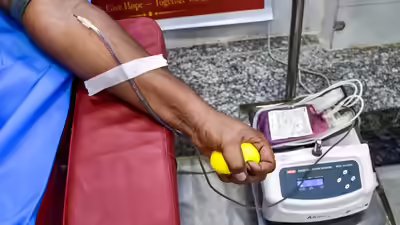
Can blood be created in a laboratory for transfusion? The answer may eventually be yes, but not yet.In November 2022, scientists in the United Kingdom carried out the world’s first transfusion of lab-grown blood as part of a clinical trial. While the experiment showed promise, the technology remains in the research stage.For now, patients who require transfusions remain entirely dependent on donated blood, most of it given voluntarily.Simply put, patients in these categories cannot survive without transfusions and face life-threatening consequences if blood is unavailable.In such cases, medicines cannot substitute for blood transfusions.
WORLD BLOOD DONOR DAY 2026
Where transfusion is non-negotiable
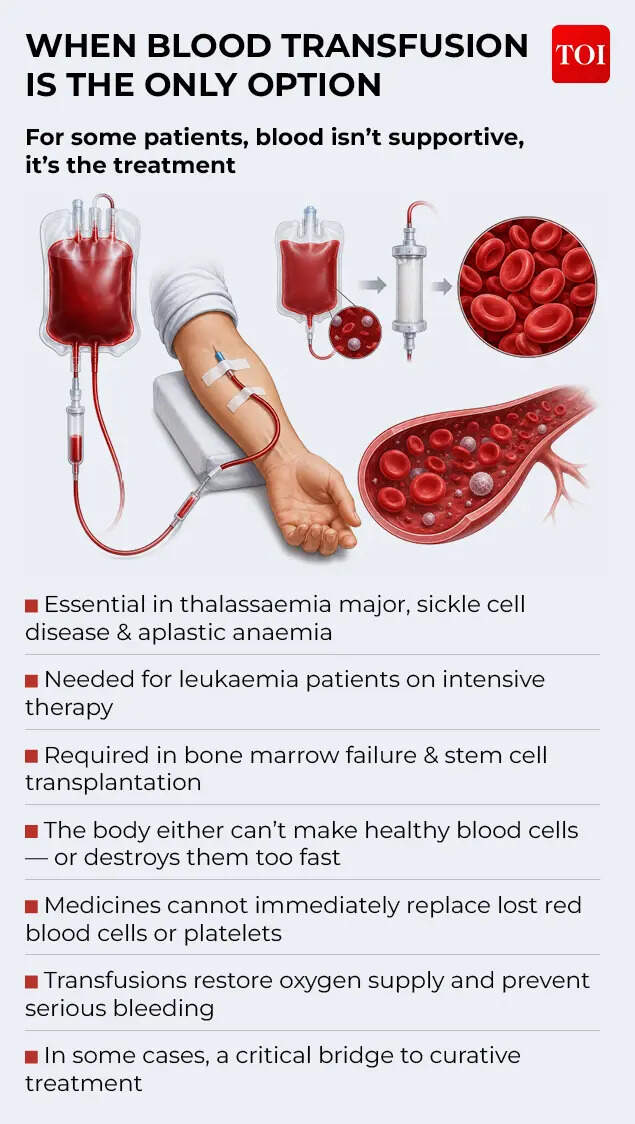
Thalassaemia major, severe aplastic anaemia, sickle cell disease, bone marrow failure syndromes, and in patients undergoing intensive treatment for leukaemia and stem cell transplantation, are conditions where blood transfusions are the primary form of treatment.“In these conditions, the body is either unable to produce adequate healthy blood cells or destroys them prematurely,” says Dr Geetika Jassal, Medical Spokesperson, Cryoviva Life Sciences.To put it simply, the patient cannot do without the blood without facing life-threatening consequences. Medicines cannot act as an alternative to the blood transfusion in such conditions.“Medications alone cannot immediately replace deficient red blood cells or platelets, nor can they restore oxygen-carrying capacity or prevent serious bleeding complications,” says Dr Jassal. “Timely and regular blood transfusions help maintain adequate tissue oxygenation, reduce disease-related complications, support ongoing treatment, and in some cases serve as a bridge to curative therapies such as stem cell transplantation.”Tapas Sengupta, former president of the Thalassaemia Society of India, Kolkata, says patients rely on both government and private blood banks.Dr Jassal notes that in patients with leukaemia or those undergoing chemotherapy, delayed platelet transfusions can significantly increase the risk of spontaneous or uncontrolled bleeding.
WHEN TRANSFUSION IS THE ONLY OPTION
Finding the right blood
Hospitals and blood banks frequently encounter situations where the required blood group or blood component is unavailable.One example is the Bombay blood group, first identified in Mumbai in 1952. It is an extremely rare blood type found predominantly in the Indian subcontinent.In India, it is estimated to occur in between one in 7,600 and one in 10,000 individuals.According to a study published in the United States’ National Institutes of Health titled ‘Transfusion reaction in a case with the rare Bombay blood group’: When patients with the Bombay phenotype can receive only autologous blood or blood from another Bombay blood group. “Transfusing blood group O red cells to them can cause a fatal hemolytic transfusion reaction,” it states.The difficulty to find blood for patients with rare blood types is not limited to the Bombay blood group, and it remains a challenge for even the world’s most advanced healthcare infrastructures.A blood bank worker said that when the required blood is unavailable, hospitals often depend on replacement donors. Family members, friends or caregivers may have to donate blood themselves or search for a compatible donor.Dr. Sadhana Mangwana, Director, Transfusion Medicine & Immunohematology, Sri Balaji Action Medical Institute said: “The gold standard is 100% voluntary, non-remunerated blood donation. India has improved, but about 30% of donations still come from replacement donors, suggesting that many hospitals continue to rely on families to arrange blood during emergencies.”Blood donations often decline during periods of extreme heat, election seasons and Ramadan, the worker said.The Covid-19 pandemic also severely disrupted blood donation drives, although supplies have since largely recovered.“Hospitals manage such situations (of blood group or component unavailability) through close coordination with regional blood centres, voluntary donor networks, and transfusion services to identify suitable donors and compatible blood products as quickly as possible,” said Dr. Jassal. Protocols have been established in hospitals that prioritize urgent cases and optimize the use of available blood resources.Such situations underscore the importance of regular voluntary blood donation. It mitigates such crises by maintaining a steady supply of life-saving blood in hospitals and blood banks.
BLOOD DONATION IN INDIA
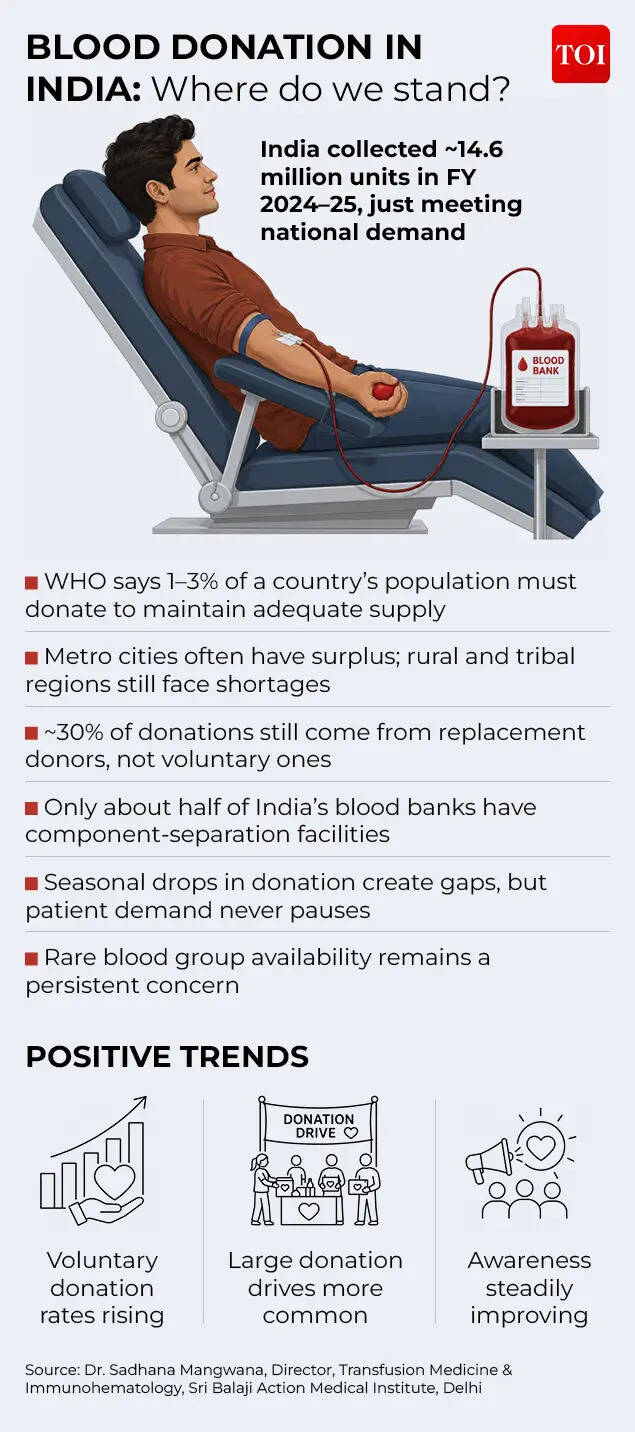
Status of blood donation in India
India has made significant strides in strengthening its blood donation network, but challenges remain in ensuring a steady and equitable supply across the country.According to a World Health Organization (WHO) report released in December 2025, India’s annual blood collection rose from 12.6 million units in 2023 to 14.6 million units in 2024, with voluntary donors contributing nearly 75% of all collections. The WHO noted that the country has continued to strengthen blood safety systems as it works toward universal access to safe blood.Despite this progress, experts say geographic disparities persist. Metropolitan and more developed states often collect surplus blood, while rural, tribal and remote regions continue to face shortages. Seasonal factors such as extreme weather, festivals and holidays can also affect donations, even as demand remains constant due to trauma cases, obstetric emergencies, cancer treatment, thalassaemia and major surgeries.Geographic inequality, dependence on replacement donors, component shortages and rising demand are some of the key challenges facing the country’s blood supply system.At the same time, awareness around voluntary donation has improved. Large-scale donation drives have become more common, voluntary donor participation has increased and dedicated donor networks now support more than 1,100 blood banks across India.Experts also stress that many fears surrounding blood donation are unfounded. Donating blood at a licensed blood centre is considered safe, with single-use equipment and rigorous testing protocols in place. The body replenishes donated blood naturally, and most donors can return to normal activities within a day. In many cases, a single donation can be separated into different blood components and help multiple patients.Doctors advise that individuals should donate only if they meet eligibility requirements, including adequate haemoglobin levels.
Theme of World Blood Donor Day , 2026
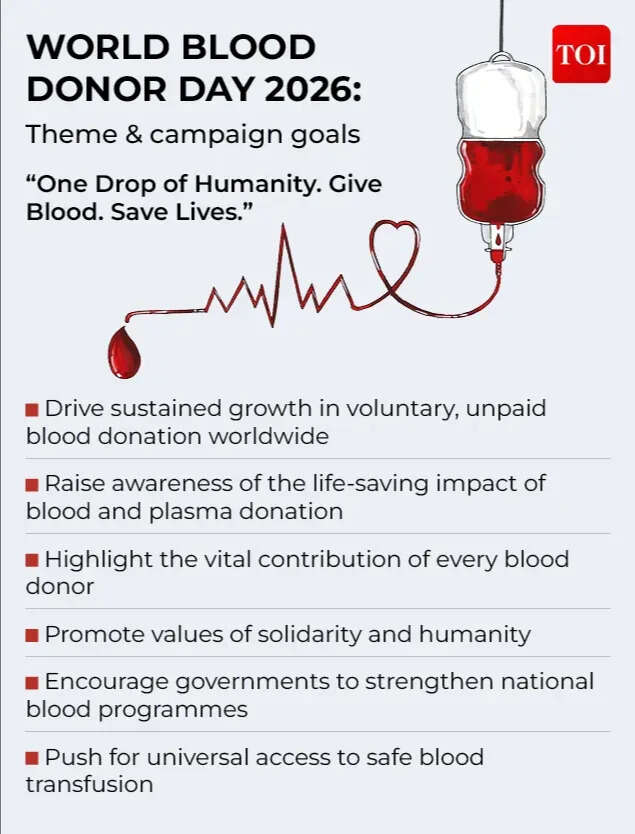
The theme of the 2026 World Blood Donor Day is “One Drop of Humanity. Give Blood. Save Lives.” According to the WHO, it places humanity at the heart of every blood donation.This year’s campaign objectives are to drive growth in regular, voluntary and unpaid blood donation across the globe. To raise awareness of the life-saving impact of blood and plasma donation. Highlight the contribution of blood donors and promote the values of solidarity and humanity. And finally, to encourage governments to strengthen and invest in national blood programmes to achieve universal access to safe blood transfusion.
THE MAN BEHIND THE DAY
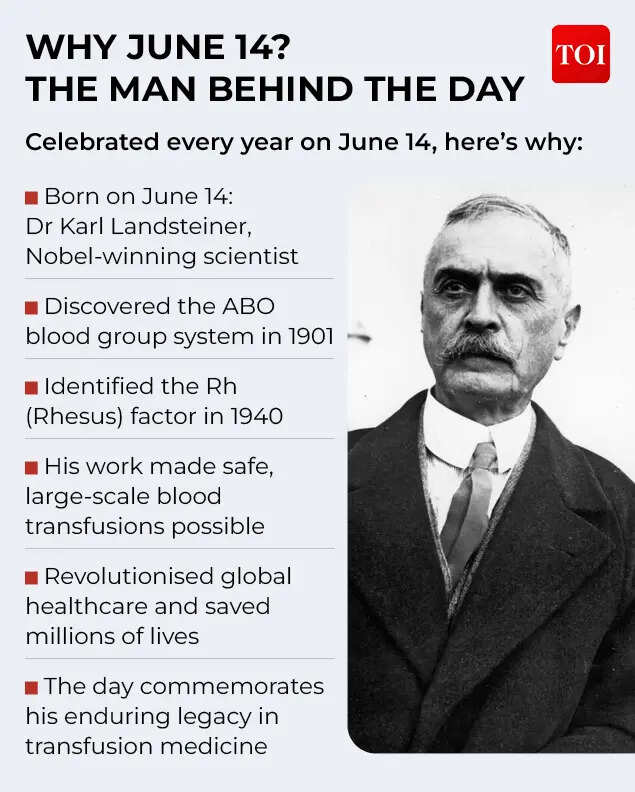
World Blood Donors Day is celebrated on June 14 each year on the birth anniversary of Dr Karl Landsteiner, who discovered the ABO blood group system in 1901 and the Rh (Rhesus) factor in 1940.The day commemorates his legacy, that revolutionized global healthcare by making safe and large-scale blood transfusions a reality.