







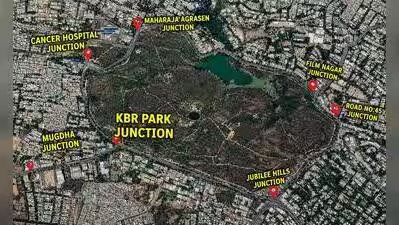
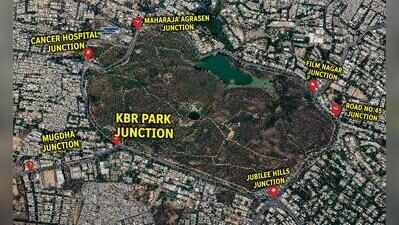
Hyderabad: Jubilee Hills checkpost handles the heaviest peak-hour traffic among the junctions surrounding KBR Park, clocking 15,321 passenger car units per hour (PCU/hr), according to data released by the traffic police during surveys conducted for the Hyderabad City Innovative and Transformative Infrastructure (H-CITI) project. KBR Park entrance follows with 13,516 PCU/hr, while Maharaja Agrasen Junction at 10,356, Road No. 45 Junction 9,966, Film Nagar 9,605 and Basavatarakam Cancer Hospital Junction 5,880 PCU/hr.To ease the traffic load, the govt has begun work on 14 structures, seven multi-level steel flyovers and seven directional underpasses, under the H-CITI project. The project carries an estimated cost of Rs 1,090 crore and is expected to take 24 months to complete. Administrative sanction for the two packages was issued on Dec 3, 2024.The first package covers Jubilee Hills checkpost, KBR Park entrance and Mugdha Junction. At KBR Park Entrance, a 330-metre, two-lane underpass will carry straight-moving traffic from Jubilee Hills checkpost towards Cancer hospital, while a 900-metre, three-lane flyover will handle right-turning traffic heading from Panjagutta towards Jubilee Hills checkpost. A separate 260-metre, three-lane underpass at Mugdha Junction will serve traffic moving from KBR Park entrance towards Panjagutta.At Jubilee Hills checkpost, the plan includes a 740-metre Y-shaped underpass, a 745-metre, four-lane flyover and a 770-metre, two-lane second-level flyover. Together, these structures will handle various straight and turning movements between Road No. 45, KBR Park entrance, Yousufguda and Road No. 36.The second package covers Road No. 45, Film Nagar, Maharaja Agrasen and Basavatarakam Cancer Hospital junctions. It includes a 290-metre underpass and 500-metre flyover at Road No. 45, a 430-metre underpass and 600-metre flyover at Film Nagar, a 410-metre underpass and 590-metre flyover at Maharaja Agrasen, and a 330-metre underpass and 540-metre flyover at the Cancer Hospital junction.The govt expects the structures to provide complete traffic relief at KBR Park entrance and the four junctions covered under the second package, while cutting bottlenecks at Jubilee Hills checkpost by 80%. The grade separators, it said, should also cut travel time and fuel consumption, while easing pollution caused by vehicles idling in queues.To facilitate construction, Hyderabad police commissioner VC Sajjanar said the one-way traffic system around KBR Park will come into effect from Aug 18. The arrangement, he said, follows detailed studies, two trial runs and coordination with GHMC. Police have consulted residents, morning walkers and RWAs, with the plan open to change based on how it plays out on the ground.“Once these multi-level structures are completed, traffic issues at KBR Park entrance, Road No. 45, Film Nagar, Maharaja Agrasen, and Cancer Hospital junctions will be 100% resolved, ensuring signal-free travel. At the heavily congested Jubilee Hills checkpost Junction, travel bottlenecks will be reduced by 80%,” Sajjanar said.He added that the project should significantly cut travel time between the core city and the IT corridor, while saving fuel and reducing the carbon emissions caused by vehicles idling for long periods. Commuters may feel some initial inconvenience once the route changes take effect from Aug 18, he acknowledged, but appealed for their cooperation. “Temporary one-way traffic is for long-term benefit,” Sajjanar said.