











Can you become an IAS officer while being an ‘expert mother’?Can women pursue demanding careers while also fulfilling the responsibilities of motherhood? Uttar Pradesh governor Anandiben Patel believes they can and should.“Whether you become an IAS officer or a teacher, first become an expert mother. Everyone should know how to cook the food prepared at home,” Patel said at the 41st convocation of Chhatrapati Shahu Ji Maharaj University.Her remarks, part of a wider message on education, family and parenting, have revived a familiar debate: what support do women have to balance careers and caregiving?Labour data suggests this balance remains difficult. For many urban women, childcare and household responsibilities, not a lack of education or ambition, remain the biggest barriers to paid work.
What the numbers say
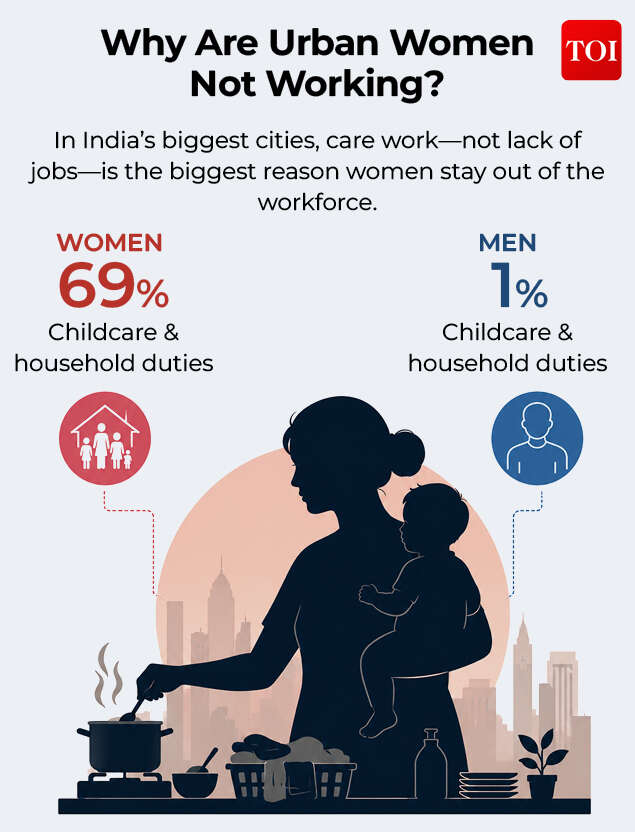
A National Statistics Office survey covering India’s 46 largest urban centres found that childcare and household responsibilities keep 69% of non-working women out of the labour force. For many women, unpaid care work remains a greater barrier to employment than education or qualifications.The gender divide is stark. Barely 1% of non-working men cite childcare or housework as the reason they are outside the workforce. Among women, it is by far the most common explanation.
Women and childcare
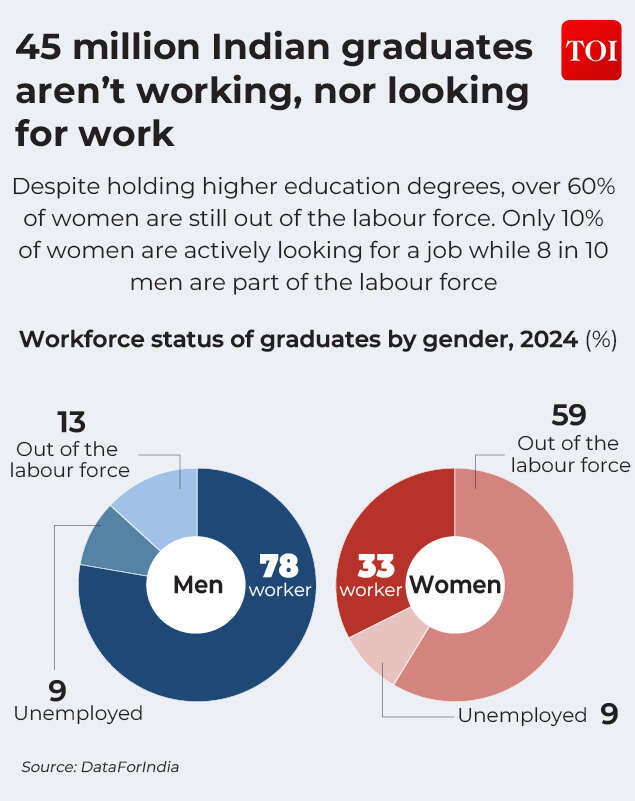
Even higher education hasn’t solved the problem. More than 60% of women graduates are neither working nor looking for work. Only around one in ten unemployed female graduates is actively searching for a job, compared with nearly eight in ten men.For many women, the challenge isn’t capability—it’s compatibility between career and caregiving responsibilities.That is something Nibha Singh Mahar, an English teacher at an Army School in Ranikhet, knows firsthand. Married at 23, she became a mother at 25 and stepped away from her career for nearly two-and-a-half years to raise her child.“I believe motherhood is an important responsibility, but becoming an ‘expert mother’ and pursuing a career are not mutually exclusive. Women should have the freedom to choose their own path. With family support, workplace flexibility and good childcare, many women successfully balance both motherhood and demanding careers,” she said.She says motherhood and professional success should never be presented as competing goals.“Moreover, motherhood is a beautiful journey that makes a woman feel complete in its own way, while becoming an IAS officer is undoubtedly a great achievement. A woman’s worth should never be measured by choosing one over the other; she should be empowered to excel in both if she wishes,” she said.
Tale of two cities
The survey also shows that women’s experiences differ sharply depending on where they live, suggesting structural differences rather than a uniform cultural mindset.In Howrah, 83% of non-working women say household and childcare duties keep them out of paid work. Surat follows at 81%, with Pimpri Chinchwad, Bhopal and Dhanbad not far behind.By contrast, the figure falls to 38% in Coimbatore and 41% in Agra, while Hyderabad, Visakhapatnam, Srinagar and Kota also report substantially lower numbers.The wide variation suggests that women’s participation in paid work may be influenced not only by social attitudes but also by factors such as childcare facilities, transport, workplace flexibility and local employment opportunities.
The missing childcare support
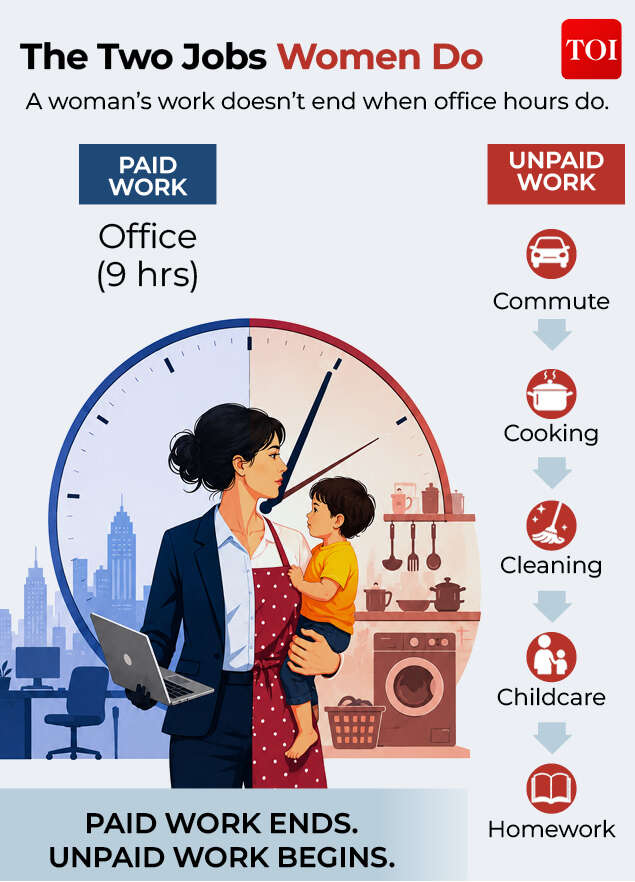
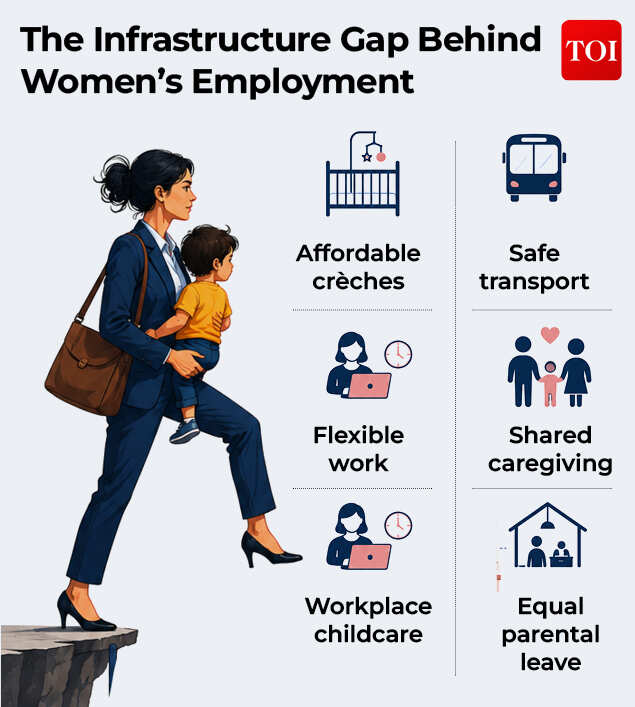
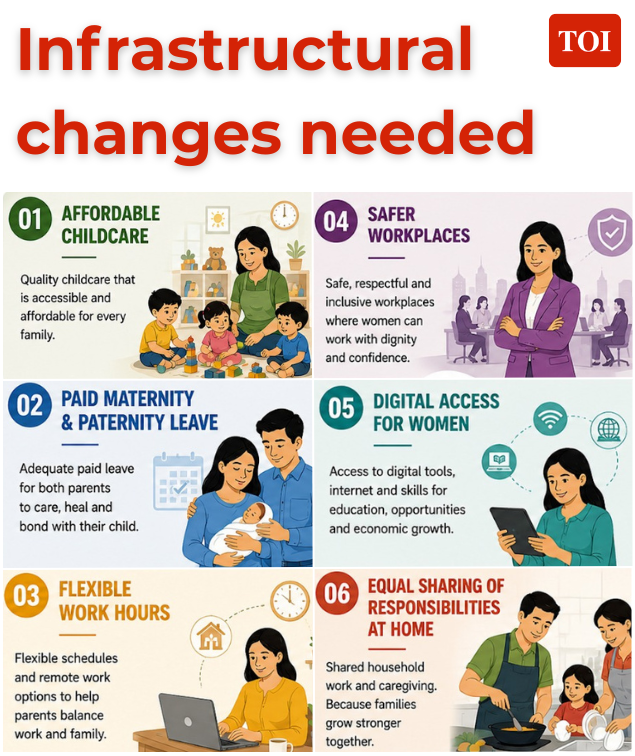
The contrast between cities underlines a larger reality: childcare remains largely a private family responsibility rather than public infrastructure.India has dramatically expanded girls’ access to education over the past two decades. But the systems that allow women to remain in paid employment—affordable crèches, reliable daycare centres, after-school care, safe transport and flexible workplaces—have not expanded at the same pace.For many mothers, every working day begins with the same question: who will look after the children?The experience of Kanchan Jha, a mathematics teacher at a private school in Surat, reflects that reality. She became a mother at 29 and again at 33, spending 12 years away from paid work to care for her children before returning to teaching.
Several tasks women do
Asked whether she had considered leaving her job because of childcare, she says:“Like many working mothers, there have been moments when balancing work and childcare felt challenging. However, with support from family and proper planning, it is possible to continue pursuing both personal and professional goals.”She recalls that the toughest phase wasn’t teaching itself, but trying to do everything at once.“The biggest challenge was managing time and dealing with the feeling that neither role was getting my complete attention. Balancing school responsibilities, household work, and the emotional needs of a young child required careful planning and a strong support system.”Her answer to what would help more women stay employed echoes what the data suggests.“Affordable and reliable childcare support would make the biggest difference. Access to quality childcare would help many mothers continue their careers while ensuring that their children receive proper care and attention.”The gaps in this support system are also visible in the implementation of existing policies.The Maternity Benefit (Amendment) Act, 2017 mandates crèche facilities in many establishments, while MGNREGA also provides for childcare at worksites. But more than 85% of India’s working women are employed in the informal sector, placing them outside the maternity law’s coverage. Even among establishments where crèches are mandatory, compliance remains poor. A 2019 VV Giri National Labour Institute study found that three out of four organisations with over 50 employees lacked the required childcare facilities.The challenge is particularly acute in agriculture, which employs more than 70% of working women, but where fewer than 1% receive maternity benefits. Under MGNREGA, awareness of childcare provisions remains low and their availability even lower. A survey in Rajasthan found that only 53% of women knew they were entitled to childcare facilities, while just 0.7% reported having a crèche at their worksite.Trust is another concern. Allegations of abuse at a Bengaluru daycare centre have also heightened concerns about children’s safety, making many mothers even more hesitant to return to work.
Missing childcare infrastructure
The gender gap at work
Women who remain in the workforce also face unequal outcomes.Across the 46 cities, salaried men earn an average of Rs 30,700 a month, compared with Rs 23,700 for women—a gap of about 23%, the NSO survey says.The disparity is wider in cities such as Kalyan-Dombivli, Navi Mumbai and Nagpur, where women earn close to half as much as men. Self-employed women fare even worse, earning less than half as much as their male counterparts.The data, however, does not suggest that women are working fewer hours. Employees across these cities work an average of nearly 50 hours a week, with salaried women in Rajkot and Faridabad among those recording the longest working hours.
Why it matters beyond households
This is not only a question of gender equality. It is also an economic issue. India has seen a gradual rise in women’s participation in the labour force. According to the latest Periodic Labour Force Survey (PLFS), the female labour force participation rate (LFPR) for those aged 15 and above rose to 35.3% in December 2025, up from 35.1% in November. Rural female LFPR reached 40.1%, while the urban rate stood at 25.3%, highlighting the persistent gap between urban and rural India. At the same time, the NSO survey of 46 cities shows that 69% of non-working urban women cite childcare and household responsibilities as the primary reason for staying out of the workforce. Together, the two datasets suggest that while more women are entering the labour market, caregiving responsibilities continue to prevent many—particularly in urban India—from participating in paid employment.
Women in workforce
The challenge, therefore, is not simply creating jobs. It is creating the conditions that enable women to take them. Without affordable childcare, flexible workplaces and better support systems, many mothers will continue to face the same practical question each morning: who will look after the children?
What the data shows
The survey identifies caregiving as the most commonly cited reason non-working women remain outside the labour force. Nearly seven in ten women reported it as a barrier, although the figure varied from 38% in Coimbatore to 83% in Howrah.Nibha Singh Mahar and Kanchan Jha both returned to work after taking career breaks to raise their children. They cited family support, planning, workplace flexibility and access to reliable childcare as important factors in balancing the two roles.Kanchan described affordable and reliable childcare as the measure that would make the biggest difference for working mothers.Nibha, meanwhile, said motherhood and professional success should not be treated as competing choices.“A woman’s worth should never be measured by choosing one over the other; she should be empowered to excel in both if she wishes,” she said.
Here are what infrastructural changes needed