


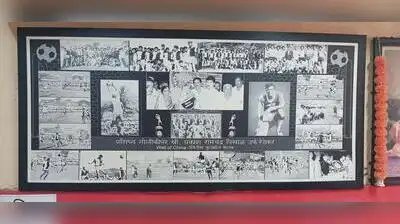
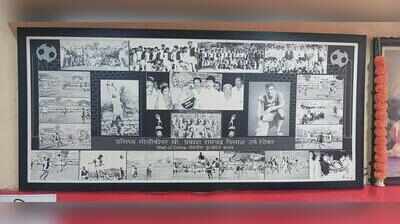
Kolhapur: Fans in Kolhapur are revelling in the underdog stories that unfolded in the 2026 FIFA World Cup. They saluted Cabo Verde when it drew with Spain, fought Uruguay to a draw powered by their 40-year-old goalkeeper Josimar José Évora Dias’s (Vozinha) heroics, admired Curacao’s World Cup debut, praised DR Congo’s 1-1 draw against Portugal and Egypt’s rise to the knockout stage.The city has an underdog football story of its own that goes back to 1936. War clouds were gathering over Europe when Major Dhyan Chand’s hockey team defeated Germany to win the gold medal in the Berlin Olympics. A few months later, a Kolhapur football club took on a trained team of the British Regiment 10 RTC and held them to a draw.The match between the now 99-year-old Practice Club and the British regiment’s team was played at Khasbaug Maidan (Shahu Stadium), when the club was barely nine years old. The odds were against the local club. They played barefoot and wore black-and-white half shirts stitched by a local tailor, a sporting outfit that remains unchanged.The troops from the regiment were moving from Pune to Bengaluru and had halted in Kolhapur for three nights. They had camped at Tarabai Park’s Bailgotha Maidan. The club requested a match and the British accepted the challenge to play with the underdogs.The match was played around Nov or Dec of 1936. Football was new to Kolhapur. It was first introduced by Rajarshi Chhatrapati Shahu Maharaj, and later patronised by his son Rajaram Maharaj, who studied in London and had a passion for football.The match drew a massive crowd. Both teams had no inclination about the other’s strengths or weaknesses, but the regimental team was disciplined and had a strategic approach, while Practice Club players were what the name indicated, youngsters who came together to practise.Their approach was rustic, but they knew they had to score a goal or stop the other team from scoring one. The heroic 1-1 draw elevated confidence among local youths. The performance laid the foundation for professional clubs in Kolhapur even though Jamdar Club was founded in 1928 was the first.The match and its glorious story was lost over time. However, when the club published a magazine in 1984, it carried pieces written by former players about the historic feat in 1936 which revived pride and it became folklore.The young footballers had no experience of playing against a trained team. All that they knew came from observing the British stationed in Kolhapur as part of the agreement between the Kolhapur royalty and the British Crown after the 1857 war of independence.Prakash Pisal, a 78-year-old who played for Practice Club between 1970 to 1990, as a goalkeeper, said, “Our predecessors would tell us about how our club drew against the British regiment. Back then, football was a ‘long pass game’, the interaction with British made it a ‘short pass game’, and Practice Club mastered the art. Spectators sat through the game hoping that the club would win.”Balasaheb Powar, who played for the club between 1967 to 1971, said, “We were proud about the draw against the British regiment’s team. During our time, we would slice six limes into halves and distribute them among 12 players at half time for the lemon break.”Pisal was hailed as ‘The Great Wall of China’ by English daily The Western Times based in Ahmedabad in Oct 1970 when Shivaji University defeated semi-finalist Jabalpur University by 2-1 in a game. “The biggest hindrance was goalkeeper Pisal P R who stood like the Great Wall of China and never allowed the ball to pass him. Had he failed to discharge his duties efficiently today the score would have read otherwise. He bought some brilliant saves and won kudos,” the newspaper wrote.He recalled a three-day thriller at Gandhi Maidan, the final match of the tournament held to mark the anniversary of Kolhapur Municipal Corporation’s foundation. “It was against Shivaji Peth’s team. Thousands of supporters of the rival team attended. On the first two days, both teams did not score and to get a clear winner the match was held on the third day. We won. I saved three penalties and one by lapping at the ball quickly. Spectators took me in a procession to my house on their shoulders,” Pisal.