








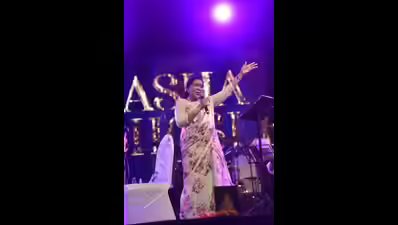

In 2010, I was asked to teach French conversational skills to nine-year-old twins. I reached the address and rang the bell. When I entered, an elderly lady in a pastel sari was making calls from a landline and humming. I froze. The voice! I was all ears until Anuja Bhosle came out and greeted me, ‘Hello Miss. Meet my mother-in-law Asha Bhosle.’I blurted out in Marathi, ‘My aunts have worked with you. Rekha and Chitra.’ Asha-tai’s eyes gleamed. They were heroines in Marathi cinema in the fifties. She asked, ‘How are Kumud and Kusum?’ I was tickled to hear their real names after years.Then two joyous children, Zanai and Ranjai, bounded in and we commenced our French lesson. Ashatai kept enquiring about my aunts. She wanted to learn the French alphabet and write her name in French. I wondered whether I should behave like a teacher or a fangirl.The twins would be studying when their grandmother would march in from a routine day at work, wearing a printed sari and sunglasses. Pausing to chat with us before going in, she would joke, ‘This teacher is very strict. Study well!’ She would speak Bangla with the children’s friend. I was mesmerised.At Christmas, we were singing ‘Jingle Bells’ in French, when Ashatai appeared and began tapping her foot. I scribbled the lyrics of ‘Vive le vent!’ in Devanagari, and she joined in the festivities.She would often chat about Marathi cinema, recalling the times she’d pick my aunts in her car and take them to recordings. Once, I tasted her chicken curry. It was creamy and delicious. I asked if it contained coconut milk. She shared her secret: not coconut, just milk. Another day she asked, ‘Do you want chicken sandwiches?’ I hesitated. She said, ‘I’m craving some, let’s order from Candies.’ We relished them over chitchat. I would always take my favourite kheerkodom for her, and she would say no one prepares this delicacy quite like the Bengalis.One day, I witnessed something priceless. Zanai was rehearsing a lively children’s song on rain, for a film. Ashatai was mentoring her, cajoling her to visualise the choreography on the big screen, showing her how to feel the rhythm and pour joy into her words.When Alliance Française asked me to interview the ‘cabaret queen’ for their magazine, Ashatai agreed immediately. I asked her which language she would prefer, Marathi, Hindi or English. She retorted, ‘I speak only French!’The interview brought alive memories of Paris, the Louvre, Impressionism and lunch at the Eiffel Tower. She said she loved ‘Gigi’—a film on Colette’s novella—fragrances of L’Occitane, Can-Can and the French language. She wanted her grandchildren to speak French—‘the world’s sweetest language’, said the lady with the sweetest voice. She smacked her lips recalling the croissants at Gaylord. I later learnt about her deep connection with gastronomy and her Indian fine-dining restaurants, Asha’s. And I witnessed her passion for cooking and feeding people. Our reverie ended with a flourish—an anecdote of her concert in Spain and Guantanamera … That piece was An Evening in Paris with Asha-tai. A gem. I was steeped in the afterglow of her joie de vivre and our tête-à-tête.That summer she took the twins to Paris, to feel the magic. For linguistic immersion.She was Ashaji to the world but ‘Asha Aai’ to her family. After my son was born, whenever we met, she never failed to ask, ‘How’s your kiddo?’ Recently, we saw her grace the performance of a Marathi comedy. She sat through the three hours and addressed the audience in the interval, ‘We must watch plays and encourage theatre. I will do a concert here soon.’ The auditorium resounded with awe and applause.On April 12, the nation was stunned into silence when such an indomitable spirit passed on, at 92. My mother and I went to pay our last respects, and we met the family after many years. Zanai saw me and all she said was, ‘She wanted to learn French.’ I just hugged her tight.