









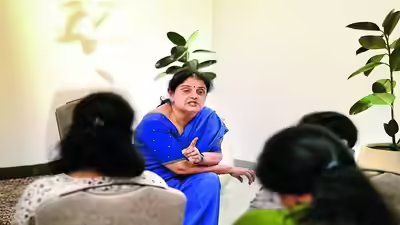
By Shloka A JatkarAs conversations about the portrayal of women in entertainment once again make headlines, a recently held seminar in Bengaluru focused on a larger question: Have we really moved beyond viewing women only through the lens of their bodies? Titled Gender, Gaze, and Authority: Challenges of Writing the Body and Gender Politics, the session was delivered by writer and academic M S Asha Devi on the opening day of the Chiguru X Kusumaale Festival. Throughout the session, Asha repeatedly returned to a central question: “Have we succeeded in seeing women in theatre as individuals, or are we still viewing them through the lens of their physical appearance?” She also reflected on the works of Girish Karnad, including Odakalu Bimba, and discussed Vaidehi’s Mallinathana Dhyana, describing it as an important cultural text that challenges conventional ideas of gender and equality. Calling on theatre practitioners to rethink how women are represented on stage, Asha said, “The question is not about giving women roles. The question is: who do we give them to? Who will create work that makes audiences think about the emotional depth of a woman?” She added, “When we bring a female character on stage, is it important to show her sexuality?”‘A woman’s body cannot be her only identity’Drawing from Kannada literature, theatre and devotional poetry, Dr Asha explored how women have asserted authority over their own narratives despite social restrictions. Referring to figures such as Bengaluru Nagarathnamma, Akkamahadevi, Neelamma and Andaal, she highlighted how these women challenged societal norms and forged identities that extended far beyond their relationships, prescribed roles or physical appearance.Speaking about Andaal’s poetry, Dr Asha argued that it should not be viewed solely as devotional literature. “When we read it carefully, we see a woman claiming authority over her desire and expressing it openly. That itself is a powerful act,” she said. Such writings, she noted, reveal how women embraced their agency and exercised the freedom to articulate their thoughts and desires.