









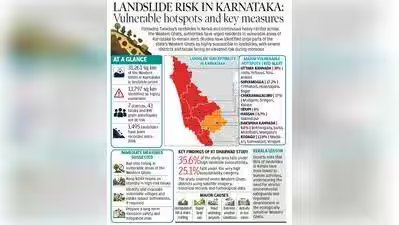
Bengaluru: Another devastating landslides in Kerala’s Wayanad have once again exposed the fragile nature of the Western Ghats, sounding a loud alarm for Karnataka’s ecologically sensitive districts where unchecked development and commercial tourism projects continue unabated.While human intervention is widely believed to have amplified the disaster in Wayanad, several studies in Karnataka, including one by IIT Dharwad, have identified hill cutting, road expansion, quarrying and unregulated tourism and hospitality infrastructure as key factors that significantly magnify the impact of extreme natural events such as landslides.Development at a costWaynad landslide lessons are starkly relevant for Karnataka’s Malnad regions—including Kodagu, Chikkamagaluru, Shivamogga, and parts of Hassan as well as the coastal districts of Uttara Kannada, Dakshina Kannada, and Udupi. These vulnerable belts have witnessed aggressive infrastructure growth over the past decade, with widening road networks and large-scale tourism projects altering hilly terrains.A comprehensive study by IIT Dharwad has revealed that over 60.7% of the Western Ghats stretch in Karnataka is highly susceptible to landslides. Conducted in the wake of the 2024 Ankola landslide, the research highlights that rapid infrastructure development and unregulated slope-cutting heavily compound risks during intense rainfall.But no lessons have been learnt by successive state govts despite Kodagu witnessing devastating floods and landslides in 2018 and 2019. Tourism-led construction remains rampant. Luxury resorts, villas, and homestays have mushroomed across Madikeri, Virajpet, and Somwarpet, with vast swathes of coffee estates being converted for commercial ventures. Chikkamagaluru has seen a similar surge around Mullayanagiri and Baba Budangiri, where hill roads are continuously widened for rising tourist traffic. The commercial footprint is expanding with equal speed around Agumbe and Sharavathi valley in Shivamogga, and across the Sakleshpur plantation belt in Hassan.Along the coast, the trend is mirror-blind. In Dakshina Kannada, major road expansion projects through the Ghats have weakened catchment areas, while Udupi has seen rapid resort development in the foothills of Karkala and Hebri. In Uttara Kannada, infrastructure expansion around Yellapur, Joida, and Dandeli continues to compromise pristine forest covers and fragile hill slopes.A ticking time bomb?Environmentalists and geologists warn that such excessive disturbance severely degrade the ecosystem’s natural resilience. Forests naturally stabilise slopes, regulate water flow, and minimise soil erosion. GN Giirish, a green activist point out that deep excavation, unscientific slope modification, and excessive groundwater extraction through borewells further hollow out hill stabilities, leaving them highly vulnerable.The tragedy has renewed calls for policy intervention. Decades ago, the Madhav Gadgil-led Western Ghats ecology expert panel had advocated strict, graded regulations for these fragile zones. Though the subsequent K Kasturirangan report diluted several of those core recommendations, it still called for a blanket ban on mining, quarrying, and large-scale constructions in ecologically sensitive areas. However, its implementation has remained entirely stalled amid political and stakeholder unholy nexus.Following the 2024 disasters, then state forest minister Eshwar Khandre indicated it would revisit the Kasturirangan report, but environmentalists argue that nothing has changed on the ground.Experts have warned that Karnataka’s Western Ghats are a ticking time bomb and that development cannot come at the cost of ecology. They have urged the state govt to mandate rigorous geological investigations, enforce strict land-use regulations, and carry out cumulative environmental impact assessments before approving any new projects in the eco-sensitive region, warning that delayed action could lead to disasters.QuoteWestern Ghats, formed about 80 million years ago, have withstood monsoon rains for millions of years, but rapid development over the past two decades has increased their vulnerability to landslides. Road widening, quarrying, deforestation, tourism infrastructure, resorts, homestays and monoculture plantations have weakened fragile slopes in Malnad-Coastal districts. Concrete structures disturb the natural soil, vegetation and drainage, making slopes unstable during heavy rainfall. The Ghats are crucial for biodiversity, river systems and monsoon patterns. Conserving these ecologically sensitive forests is vital to protect Karnataka’s environment, agriculture and water security.Suresh Heblikar | Environmentalist and filmmaker