
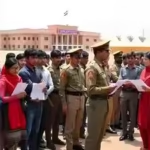










Ahmedabad: The preliminary post-mortem report in the 34-year-old murder case detected in the city has indicated that the skeletal remains recovered from Vatva are likely those of Farzana Radhanpuri, police said, adding that final confirmation will depend on DNA analysis.A senior officer of the city crime branch told TOI, “The forensic post-mortem report suggests the remains are of a female, and the estimated height matches that of Farzana Radhanpuri. However, DNA examination is required for conclusive identification.” The remains were exhumed from a property in Qutubnagar of Vatva last week during a probe into a suspected murder dating back to 1992. Police recovered bones and teeth from a septic tank area after acting on specific inputs. Officials said the condition of the remains has made forensic examination complicated. “The incident is over three decades old. The bones have hardened and have undergone decomposition. There are indications that salt was used, possibly to speed up decomposition and destroy evidence,” the officer said. He added that the process of DNA extraction is expected to take time. “Due to calcification, the bones need to be cut and processed carefully to obtain usable samples. Matching them with reference DNA will require time,” he said. Meanwhile, investigators have traced the prime accused, Shamshuddin Khedawala, who was earlier believed to be dead. Police said he was living on the outskirts of Ahmedabad and working as a taxi driver after leaving his residence in Jamalpur in 2015. “His location has been identified, and efforts are underway to question him regarding his role in the case,” the officer said. According to the investigation, the victim and the accused were in a relationship, and disputes related to property are suspected to be the motive behind the alleged killing. Police are also verifying claims regarding the nature of their relationship and circumstances leading to the incident. The case came to light after police received inputs linked to activities at the property where the remains were found. Subsequent excavation led to the recovery of skeletal remains buried deep underground.