








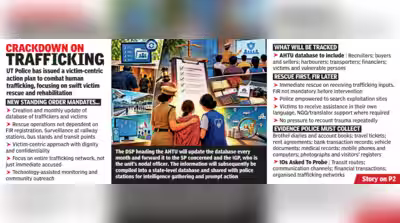
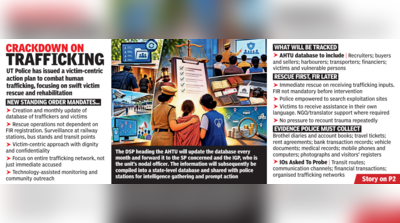
Chandigarh: Chandigarh Police has issued a comprehensive standing order laying down a victim-centric action plan to prevent human trafficking for commercial sexual exploitation, ensure the immediate rescue of victims, and strengthen investigations against organised trafficking networks.The standing order, issued by UT DGP Dr Sagar Preet Hooda on Nov 11, follows the Supreme Court’s directions in the Prajwala vs Union of India and Others case. It supersedes Standing Order No. 08/2016 and makes compliance mandatory for all sub-divisional police officers, DSPs, SHOs, inspectors and unit in-charges.A key feature of the new protocol is the creation and regular updating of a comprehensive database of traffickers, exploiters and victims. The Anti-Human Trafficking Unit (AHTU) will maintain information on recruiters, buyers, sellers, harbourers, transporters and financiers involved in trafficking networks. It will also maintain a separate database of victims and vulnerable persons to prevent repeat trafficking.The DSP heading the AHTU will update the database every month and forward it to the SP concerned and the Inspector General of Police, who is the unit’s nodal officer. The information will subsequently be compiled into a state-level database and shared with police stations for intelligence gathering and prompt action. The data will also be sent to the Return Writer Branch for onward transmission to the National Crime Records Bureau.The order directs police personnel to maintain surveillance at railway stations, bus stands and other transit points to identify potential trafficking victims. AHTUs have also been asked to identify vulnerable areas and undertake targeted awareness and empowerment programmes in coordination with NGOs and other government agencies.Rescue cannot wait for FIREmphasising immediate intervention, the standing order makes it clear that registration of an FIR is not a prerequisite for rescuing victims. Whenever police receive information about trafficking or commercial sexual exploitation, rescue operations must be initiated immediately. Police are also authorised to search premises where commercial sexual exploitation is being carried out under the relevant provisions of the Immoral Traffic (Prevention) Act.The protocol calls for community-based outreach, victim-led identification and technology-assisted surveillance instead of relying exclusively on unplanned or publicised mass raids.It also stresses that victims must be treated with dignity and sensitivity, with their best interests prioritised to prevent secondary victimisation. Police have been directed to ensure that statements are recorded in the victim’s language, with assistance from an NGO or translator wherever necessary. Victims should not be pressured to recount details of sexual violence or trauma.Focus on entire trafficking networkThe standing order directs investigating officers to look beyond the immediate accused and establish the entire trafficking chain, including source, transit and destination points, transportation arrangements, communication channels and financial transactions.Police have been instructed to collect material evidence from the scene during or immediately after rescue operations, as traffickers may attempt to destroy or conceal it. The evidence includes brothel diaries and account books, travel tickets, rent agreements, bank records, vehicle documents, medical records, mobile phones, computers, photographs and visitors’ registers.The order also directs police to initiate proceedings for the eviction of offenders and closure of brothels or other places of exploitation under Section 18 of the ITPA.Special Police Officers notified by the Chandigarh administration have been authorised to rescue victims and investigate offences under the Act. The standing order also provides for regular training of AHTU personnel, police officers, government officials and NGO representatives on legal procedures, human rights, investigation techniques and psychosocial support.For foreign nationals rescued during operations, police must inform the nodal police officer of the concerned country or state and follow the guidelines issued by the Union home ministry.The DGP has directed all police units to strictly comply with the Supreme Court’s directions and the Union home ministry’s Aug 28, 2026, guidelines on countering trafficking in persons.