









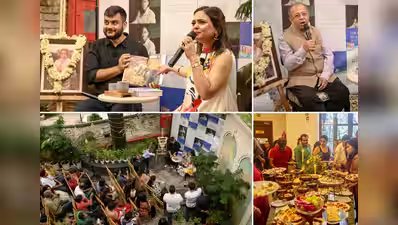
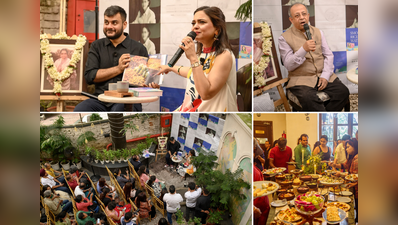
“In my household, when we’re not eating, it’s about khawa-dawa, ranna, bajaar – we’re thinking about the next meal as we’re eating our first meal,” said Chef Kishwar Chowdhury on what her probashi Bengali upbringing in Australia was like. What unfolded on cool Monday afternoon under the shade of the mango trees at The Bhawanipur House was a cosy adda about what Bengalis love best: Food of course! Chef Kishwar Chowdhury’s debut cookbook, Smoke Rice Water brought her to Kolkata and she indulged in conversations about food, culture and more. Kishwar is the Melbourne-born chef who won hearts in 2021 when she served panta bhat, the humblest of Bengali breakfasts, in the MasterChef Australia finale and became the second runners up. Her Bengali lineage is strong with her mother hailing from Kolkata and her father from Bangladesh. Hosted by curator and photographer Kounteya Sinha, the afternoon was opened by food historian Jayanta Sengupta, while Chef Auroni Mookerjee led the adda into familiar Bengali territory. CT was there to chat with Kishwar and find put what seasonality and representation in food actually mean to her.
Why aren’t we putting our voices on the global stage? There is power in numbers, power in unity, and that’s why I cook like this
Kishwar Chowdhury
Peeling onions at threeChef Auroni opened the adda asking Kishwar: what was the first dish she ever cooked? While she Kishwar couldn’t say, she remembered peeling onions at three or four, and the Pujo kitchens in Melbourne with no caterers, only aunties. “I just remember the kitchen and people gathering together, intergenerationally, for the service of food,” she said. Being from a migrant family, Kishwar said familiar ingredients weren’t alwats available: “You can get flour, but you can’t get atta,” she said, so the family became gardeners, and then eventually they had the land to farm and rear animals. Her childhood home, she said, was “a recollection of two homesick Bengalis”.
In joint families, somebody perfects the phulko luchi, somebody makes the best chatni. That’s how a good brigade works. Communities always come together to create it
Chef Auroni Mookerjee
A table beyond bordersTalk turned to identity. Eurocentric cuisine tops the world’s food hierarchy, Kishwar said, and Bengalis are guilty too: “We are very, very racist towards our own food.” Flipping through her pages, she pointed to nargisi kofta as the precursor of the Scotch egg. Talking about representation and coming together to celebrate our own food history, she said: “Don’t build higher walls, build longer tables.”
Bengali food is not a footnote in the history of Indian food. It stands on its own with pride, with all great cuisines of the world
Jayanta Sengupta
Travelling through the pageWe chatted with Kishwar post the event and when asked which cookbooks shaped hers, Kishwar named Sami Tamimi and Yotam Ottolenghi, whose books, she said, sparked something by taking readers into Jerusalem and Palestine. That idea of travelling vicariously through food stayed with her. “It’s why I collect the books,” she said. “I want to vicariously travel. I want to be there in Istanbul. I want to be everywhere through cooking.” She wanted her own pages to do the same for Bengal, letting readers step into a home: the people in the markets, the hands cooking, the cooks making kacchi biryani in Bangladesh. The photography carried that intimacy, she said, but storytelling was “a massive part of it”, giving readers a sense of Bengali culture, food and way of life.
My journey on MasterChef wasn’t easy. I was very emotional every time I made Bengali food. There is racism in food. There is a hierarchy of food where we put Eurocentric cuisine at the very top of what we think is worth it, and we can sit here and say, the West is racist towards our food. We are racist towards our own food because when make a menu with things like shaak, they say, “Ami taka diye eta khete jabo keno?” People are going to pay for that bowl of pasta, or sushi and even Asian food. But we are racist towards our own food. I know this because I’ve heard many times. So yes, I took the opportunity and the platform. I was stripping that away and not because we can’t cook anything else. We want to cook this. This is the revolution. We need to really decolonise our kitchens, our minds, and we really need to celebrate who we are
Kishwar Chowdhury
‘Cooking is a life skill’Midway through the chat with Auroni, Kishwar turned to the audience with a challenge. In Australia, she said, every child learns to swim, yet cooking, something we do three times a day, is rarely taught as a life skill, which she finds baffling. “You can live your whole life without ever riding a bike. You can live your whole life without tying your shoelaces,” she said. “How can you live your life without eating?” Her message was for “all the boys and girls in the room right now”: busy lives are no excuse. Whether it is the bajar, a supermarket or a delivery app, she said, every adult should know how to get ingredients and put one meal in front of themselves.