








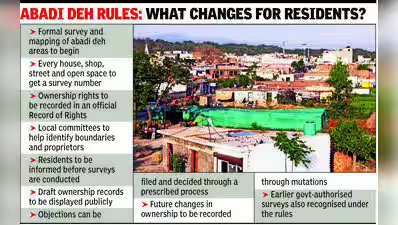
Chandigarh: In a move expected to address long-standing ownership ambiguities in village abadi areas, the Chandigarh administration has notified the Chandigarh Abadi Deh (Record of Rights) Rules, 2026, setting up a formal mechanism to survey properties, demarcate boundaries and record ownership rights in the city’s erstwhile villages. The rules, published in the official gazette on July 29, establish the administrative framework for preparing a permanent record of rights, while providing residents an opportunity to raise objections before entries are finalised.The rules, notified on July 24, lay down the procedure for identifying abadi deh boundaries, surveying individual properties, determining proprietorship and preparing a standing record of rights. They came into force with their publication in the official gazette.Under the framework, the administrator can appoint serving or retired revenue officials, officials of local govt bodies or other qualified persons as survey officers. They will be responsible for identifying boundaries, carrying out measurements, numbering survey units and preparing field records.To assist in the exercise, a local committee of up to seven members will be constituted to help identify and demarcate abadi deh boundaries and determine the person best entitled to be recorded as proprietor. The committee will include the mayor or a nominee, the municipal councillor concerned and, where available, a retired armed forces or Central Armed Police Forces officer residing in the abadi deh, besides other respected local residents. The rules also provide for representation of women and Scheduled Castes in specified circumstances.Residents to be informed before surveyThe administration has prescribed a public process before officials enter abadi deh areas for surveys. Survey officers will publicise the date of visits through proclamations, notices at conspicuous places and intimation to the municipal body. A general gathering will also be held to explain the survey process to residents.Officials authorised for the exercise may enter vacant land at any time, while inhabited premises can be entered between sunrise and sunset after prior intimation to occupants.The survey will assign consecutive numbers to dwelling and habitable areas beginning with number one. Records will specify whether a survey unit is a house, shop, street, institutional building, open area or common property. Documents submitted by residents regarding the boundary, area or nature of a property may also be considered.Objection mechanism built into processProposed ownership entries will be published in Form B after the assistant recording and resolution officer hears interested parties and examines relevant documents. In cases where a property has been subdivided, separate numbers and areas will be recorded for each portion.The survey map and proposed ownership records will subsequently be displayed at conspicuous locations, including cooperative societies, patwar khanas, dharamsalas, community centres and common religious places, inviting objections from residents.Objections can be filed before the assistant recording and resolution officer in Form C. The officer will examine the objections, conduct inquiries where necessary and pass a speaking order on each case. Any changes to the area, boundary or dimensions of a survey unit will be incorporated into the field book.Once objections are disposed of, the final Record of Rights will be prepared in Form D, published and transferred to the District Collector, with one set maintained by the Patwari.Mutation process definedThe rules also provide for subsequent changes in ownership to be recorded through a prescribed mutation process. Acquisition of rights through inheritance, succession, purchase, mortgage or other means, once reported to the revenue Patwari, will be entered in Form E.Importantly, the rules validate surveys and mapping exercises already carried out by Centre or state govt agencies for identifying abadi deh boundaries and demarcating units, provided they were undertaken under the directions of the district collector or the administrator. Such surveys cannot be challenged merely because they were conducted before the Act or the new rules came into force.With the notification, the administration has put in place the legal and administrative machinery required to convert Chandigarh’s abadi deh areas into a formal record of rights, bringing surveys, ownership determination, public scrutiny, objections, corrections and future mutations under a single framework.