









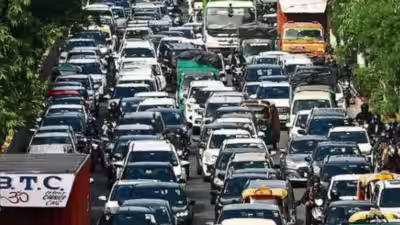
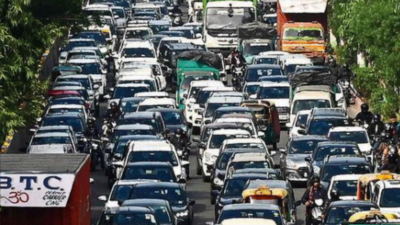
LUCKNOW: Uttar Pradesh Police has reported a significant reduction in traffic congestion across the state’s police commissionerates following the implementation of its Artificial Intelligence-powered Reducing Traffic Congestion (RTC) initiative, a first-of-its-kind, Google-based real-time traffic analytics system designed to monitor, predict and manage road congestion using AI and live data.The technology-driven initiative is being implemented in line with chief minister Yogi Adityanath’s vision of providing citizens with safe, seamless and time-bound transportation facilities across the state.The RTC project is being spearheaded under the leadership of Director General of Police (DGP) Rajeev Krishna and the guidance of Additional Director General of Police (Traffic) A. Satish Ganesh. The system integrates Artificial Intelligence, Google-based real-time traffic inputs and advanced data analytics to enable scientific and proactive traffic management across major urban centres in Uttar Pradesh.AI-based real-time monitoringAccording to the Uttar Pradesh Police Headquarters, RTC is the country’s first indigenously developed AI-enabled, Google-based Real-Time Traffic Analytics platform aimed at identifying congestion hotspots, analysing traffic conditions instantly and enabling swift interventions to restore normal traffic flow.Unlike conventional traffic management methods that largely depended on visual inspections or officers’ experience, the RTC system assesses congestion using quantifiable and scientific parameters.The platform continuously compares a route’s actual travel time, average travel time under normal conditions and travel delay to determine congestion levels. This allows authorities to objectively measure traffic snarls rather than relying on subjective assessments.The system automatically analyses Google-based real-time traffic data every two hours. Baseline average travel times have been established for every identified route. Whenever the actual travel time exceeds the predetermined average, the Gati-UP AI platform automatically flags the route as a congestion hotspot, prompting immediate intervention by traffic authorities.Officials said the initiative has shifted Uttar Pradesh’s traffic management approach from a reactive model—where action was taken only after traffic jams occurred—to a predictive, real-time system capable of identifying emerging congestion before it worsens.Instead of evaluating traffic conditions merely through vehicle counts or enforcement statistics such as traffic challans, the new system measures performance primarily through the actual time commuters take to travel between two points.The AI platform analyses thousands of traffic data points every day and immediately alerts officials about routes requiring intervention.Significant reduction in traffic congestionUnder the RTC initiative, Uttar Pradesh Police is currently conducting continuous real-time monitoring and traffic analysis on 74 major routes, covering a cumulative stretch of approximately 710 kilometres, across all police commissionerates in the state.According to a comparative analysis covering the period from March to July 15, 2026, the initiative has resulted in substantial reductions in traffic congestion across several cities.Among all commissionerates, Prayagraj recorded the highest reduction in congestion at 44.92 per cent, followed by Ghaziabad at 43.15 per cent.Other commissionerates also reported notable improvements, with Varanasi recording a 20.75 per cent reduction, Lucknow 13.67 per cent, Kanpur 13.19 per cent, Agra 10.99 per cent, and Noida 10.10 per cent.Police attributed the improvement to a combination of scientific route identification, travel-time analysis, congestion mapping, deployment of route marshals, assignment of route-specific officers responsible for individual corridors, daily data-driven reviews, and targeted interventions including traffic engineering measures, enforcement drives and encroachment removal.Shift towards data-driven governanceOfficials said the RTC initiative represents a transformation of Uttar Pradesh’s traditional traffic management framework into a modern, data-driven governance model.Apart from reducing congestion, the system is expected to shorten travel times for commuters, reduce fuel consumption, minimise unnecessary vehicle idling, lower air pollution and enhance overall road safety.The initiative has also enabled more efficient deployment of police personnel and resources by directing enforcement efforts towards identified congestion hotspots rather than relying on routine traffic management practices.Expansion planned across Uttar PradeshThe Traffic Directorate said its objective extends beyond merely easing congestion and focuses on building a safe, smart, citizen-centric and technology-driven traffic management ecosystem.Following encouraging results in police commissionerates, the RTC model is now being expanded in a phased manner to other cities and districts across Uttar Pradesh. Officials said the expansion is expected to further strengthen the state’s position as one of the country’s leading adopters of AI-based smart traffic management systems.