







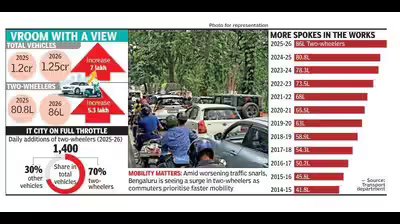
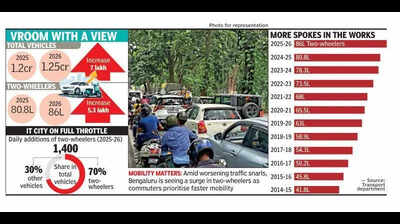
Bengaluru: With infrastructure upgrade and last-minute connectivity still in the works, and bumper-to-bumper traffic remaining the order of the day, more and more Bengalureans are turning to two-wheelers — the silver bullet for all commuting ills. This segment is growing on a tear with 1,400 new bikes and scooters hitting the road every day. Bengaluru could count one crore two-wheelers on its roads within three years.While the city’s two-wheelers hit the 50-lakh mark in 2017, the volume is set to double in under 12 years — adding an average of more than four lakh bikes every year. The scale of this growth is striking. During 2025–26, over 5.2 lakh two-wheelers were added, taking the total past 86 lakh (out of 1.2 crore vehicles overall).This means two-wheelers now make up nearly 70% of Bengaluru’s traffic — or, two of every three vehicles is a bike or a scooter. This firmly establishes two-wheelers as the backbone of daily commuting. Transport officials say the surge shows no signs of slowing down. Registrations grew by 6.5% compared to the previous year; monthly trends, too, reconfirm sharp spikes.A senior transport department official said: “Going by the trend, Bengaluru will have more motorcycles and scooters within the next 2.5 years. Following GST rate reset, there was a noticeable spike in two-wheeler registrations. In the previous financial year, the highest number of new two-wheeler registrations (59,863) was recorded in Oct — an average of 1,931 vehicles a day. Jan 2026 saw the second highest, with the addition of 50,237 units. Over the years, Bengaluru has remained a strong market for this segment.”Not unexpectedly, several factors are driving this two-wheeler craze. High public transport costs, particularly on Namma Metro, have pushed many commuters towards bikes and scooters. For long commutes, a single passenger can end up spending close to Rs 200 per day on Metro travel alone. If a passenger travels five days a week, she ends up spending Rs 4,000 a month on Metro. But a two-wheeler saves both money and time, and helps in negotiating the innards of Bengaluru’s residential maze.In addition, last-mile connectivity remains a major challenge. Commuters often incur extra expenses on parking, as well as on autos or bike taxis to reach their final destination, significantly increasing the overall travel costs. As a result, many find using their own two-wheelers a more economical and convenient option.The lack of a well-integrated public transport system is another key factor. In areas such as the Outer Ring Road, long-pending demands for Metro connectivity are yet to be fulfilled, forcing office-goers to rely heavily on private modes of transport for their daily commute.