






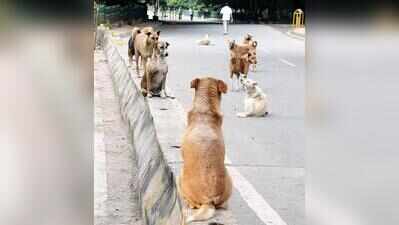
Bengaluru: Why has the stray dog population not reduced in Bengaluru despite spending more than Rs 100 crore on Animal Birth Control (ABC) programmes?More than 20 lakh saplings were planted across Bengaluru in the past two decades, but only around 9 lakh trees exist. Where did the rest disappear?These two questions — never asked so directly by chief minister or any minister so far — shot by Bengaluru development minister Krishna Byre Gowda on Tuesday left civic officials stumped. Muddled replies from Greater Bengaluru Authority officials made it obvious they were not in sync with reality. “I have not received any constructive answers,” the minister said.Excerpts from a GBA review meeting:Who let the dogs out?Despite spending Rs 42 crore in five years, Bengaluru’s stray dog population has declined only marginally. Why has the ABC programme not been effective, Gowda asked officials from the animal husbandry dept of GBA at a review meeting. Gowda said the stray dog issue has continued for decades despite sterilisation efforts.“The government has been trying to address the issue for over 50 years. This is not a new problem. Neither have we found a lasting solution nor has the problem reduced significantly,” he said.According to official data, Bengaluru had 3.1 lakh stray dogs in the 2019 census. The 2023 survey put the number at 2.79 lakh — a decline Gowda termed ‘marginal’ considering the scale and duration of the sterilisation programme.Questioning officials on the numbers, Gowda said between 2016-17 and 2023, Bengaluru conducted 3.3 lakh ABC surgeries. Given that the average lifespan of a stray dog in urban conditions is eight years, the number of surgeries exceeds the city’s recorded stray dog population in 2019 — which is 3.1 lakh.“If the sterilisation numbers are accurate, why has the population not reduced drastically? If we have achieved near-total sterilisation, how do we still have close to 2.8 lakh stray dogs? The numbers do not add up,” Gowda said.The minister said he did not receive a convincing explanation from officials. “If we continue the programme in the same manner, we will never be able to solve the stray dog issue,” he said.Gowda raised concerns over expenditure on the programme. He estimated that Rs 100-150 crore may have been spent over the past 25 years.Solution: To improve outcomes, the minister directed officials to scale up sterilisation efforts. While Bengaluru currently performs 40,000-45,000 ABC surgeries annually, Gowda has set a target of 90,000 to one lakh sterilisations every year for the next three years.Where did the trees go?Next on the agenda: Tree plantation programme. Gowda asked officials to explain what happened to lakhs of saplings planted in two decades but missing from current tree census records.Gowda said BBMP forest records show 20 lakh saplings were planted across Bengaluru since 2008. However, data from the ongoing tree census paints a different picture.Officials said nearly 85% of the census has been completed and the survey has so far identified 9 lakh trees within the city limits. The count excludes trees located in major green campuses such as Cubbon Park, Lalbagh, IISc, GKVK, Bengaluru University and other large institutional lands.“If over 20 lakh trees have been planted since 2008 and there are only 9 lakh trees identified in the census, what happened to the rest?” Gowda asked. He further questioned what happened to trees planted before 2008, including those dating back to the era of the Mysuru Maharajas, saying officials failed to provide a satisfactory explanation.The minister scrutinised expenditure incurred on plantation activities. According to the forest wing, the cost of planting and maintaining a sapling under the Greater Bengaluru Authority (GBA) programme is around ₹2,300, while compensatory afforestation plantations cost about Rs 3,108 per sapling.Officials informed the meeting that the Rs 2,300 expenditure includes Rs 300 for digging and closing the pit, Rs 135 for the sapling, Rs 452 for a tree guard, Rs 18 for support sticks, Rs 1,064 for watering, Rs 114 towards security and Rs 119 for miscellaneous expenses. These costs cover maintenance for a period of three years.However, Gowda questioned whether saplings were being planted according to prescribed standards. Referring to his observations from his own constituency, he said he had rarely seen pits dug to the required dimensions before plantation.Solution: The minister said the focus should now be on creating a transparent system to track plantations and survival rates. The city plans to plant around 64,000 saplings this year. Gowda directed officials to involve residents more actively in the programme, with Resident Welfare Associations being given priority for new plantations.