









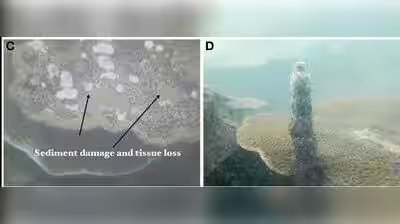
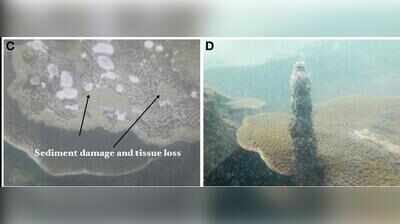
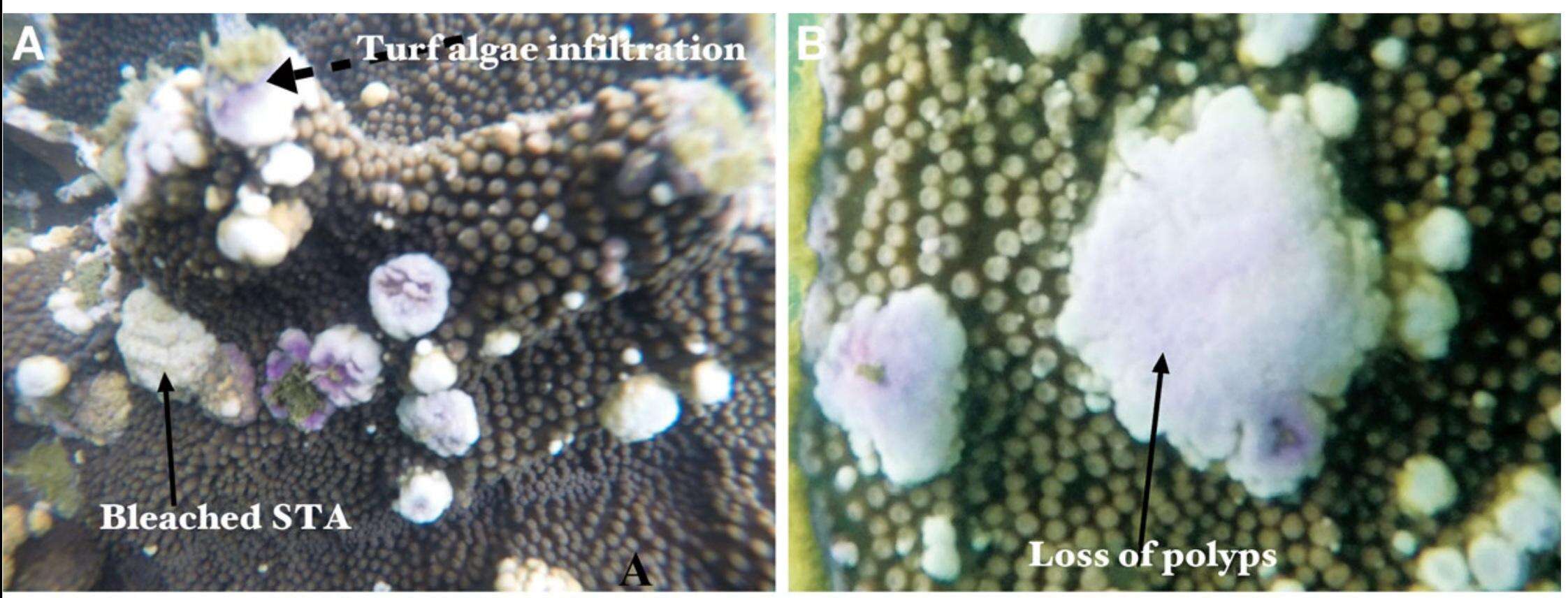
Panaji: Scientists from the Goa-based National Institute of Oceanography (CSIR-NIO) have documented tumor-like skeletal growths in Turbinaria corals for the first time anywhere in the world, warning that the abnormalities could threaten coral health and the marine ecosystems that depend on them.Known as skeletal tissue growth anomalies (STAs), the abnormal, bulbous growths have previously been reported in around 16 Caribbean and 24 Indo-Pacific coral species. However, the latest finding is the first recorded instance of STAs in Turbinaria corals and the first detailed scientific report of such coral tumours along the Indian coast.The discovery was made during scuba surveys in the Malvan Marine Sanctuary, a protected marine area along India’s west coast. Researchers mapped coral health across belt transects at two depths and documented the abnormalities in affected colonies.STAs appear as spherical or irregular, bleached masses protruding from the coral skeleton. In about 25% of cases, smaller growths expanded and fused to form large, swollen clusters. The affected regions had lost their natural colour and contained few or no polyps, severely compromising the coral’s ability to feed and produce energy.Nearly 70% of colonies affected by STAs showed severe tissue loss and were colonised by dark green turf algae. Scientists observed that the abnormal growths progressively damaged and killed the healthy tissue surrounding them.Turbinaria corals normally form broad, flat, plate-like structures. However, the researchers also observed abnormal funnel-shaped colonies in which sand and sediment accumulated in the centre. The heavy sediment load appeared to trigger pillar-like skeletal growths as the coral attempted to clear the material.The study found that colony size was the strongest factor associated with the occurrence of STAs. Larger and older colonies were more likely to develop the abnormalities, potentially because they have a longer history of exposure to physical damage, pollution, and other environmental stresses.The formation of these skeletal abnormalities is also believed to impose a significant energy burden on corals. Instead of allocating energy to growth, reproduction and coping with heat stress, affected corals may draw on their lipid reserves to sustain the abnormal tissue and skeletal development, potentially leaving them more vulnerable to further stress and mortality.The exact cause of STAs remains unknown. Scientists have identified several possible triggers, including water pollution, ultraviolet radiation, sediment accumulation, and infections.The researchers said the findings highlight the need for closer monitoring and stronger protection of coral habitats such as the Malvan Marine Sanctuary, as continued environmental stress could further weaken these vital marine ecosystems.
Coral Tumors