









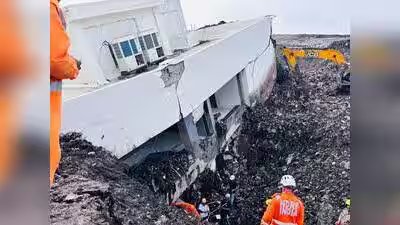
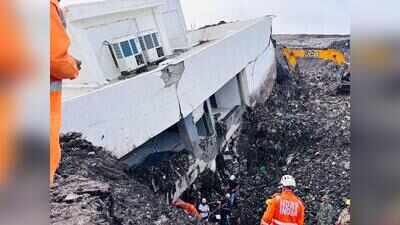
Pune: The answer everybody tracking Wednesday’s disaster in Moshi wants to know is if construction norms to build the waste-to-energy plant’s administrative building, just 30 metres away from the garbage mountains, had been adhered to.The building caved in when tons of garbage slid and slammed into it, burying at least 23 people. Five people walked to safety immediately after the mishap, and nine others were rescued but one person died and at least eight others are still trapped with rescue operations going on for the second day.Shantini Bokil, professor and programme director in the department of civil engineering at MIT (WPU), said that any structure constructed on a site close to a landfill like Moshi’s must follow certain norms and specialised foundation techniques to handle soft and shifting waste.The most important rule to follow at such plants are the slopes of the garbage mounds at the site. Due process is mandatory even at the stage of garbage dumping so that the slope is not overburdened and it doesn’t collapse, she said.“Given that the building is a govt site, I assume that the technical building norms were followed. In addition, air pockets in such garbage dumps could have been replaced with water after the recent heavy showers, weighing down the mound, triggering a slip and sending the waste crashing into the building,” Bokil told TOI.Air pockets are formed in mounds of mixed waste since the decomposition levels of various items are different. As the items shrink they leave physical voids and air pockets in the waste.Another reason for the garbage to collapse on the building could have been the heavy rains. “Incessant showers for three days could have swept away the soil under the garbage. Buildings that are three-storey tall have piles that extend deep into the soil primarily below the waste layer. The structural engineer who worked on the project will be able to tell,” Bokil added.Other factors that could have contributed to the buckling of the building include the quality of construction material. Such facilities need higher quality of concrete and coated steel to prevent rusting triggered by pollution from the garbage depot.Sameer Shastri, head of the department of civil engineering, Sinhgad College of Engineering, said, “The collapse needs to be studied in detail to understand why it happened. Factors like the concrete used, the height of the garbage heap that fell on the building and the quality of its construction itself will all play a role. Assuming it was built following all norms for a structure so close to a waste plant, the leachate that flows out from the garbage could also have contributed to the accident.”InsetCanteen worker Sujata Shinde, one of the victims rescued alive on Wednesday, said they were having lunch. “Around 16 people were inside. Some had just started eating when the garbage mound came crashing through. Those who were facing it saw it collapsing and immediately ran towards the exit. The rest of us followed them. We were trapped under the debris, surrounded by complete darkness for nearly five hours. I could not hear anything from outside. A co-worker kept trying to communicate with the rescue teams and others tried to call people outside. A senior colleague suffered a leg injury and was in severe pain.”With inputs from Alim Shaikh