








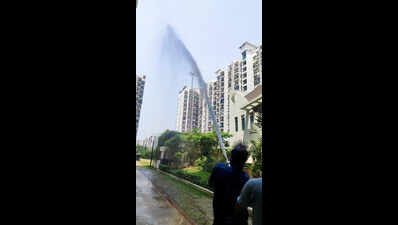
Noida: A day after a highrise fire in neighbouring Ghaziabad exposed the vulnerability of firefighting equipment in NCR, residents of 7x sectors — among the dozens of densely packed residential areas in the city that have risen, floor by floor, over the past two decades — on Thursday demanded that fire engines be stationed closer to home to reduce emergency response time and drone technology to supplement traditional firefighting.Amit Gupta, a resident of Sector 77, wrote to the chief fire officer (CFO), district magistrate and Noida Authority CEO, urging that a single fire tender be stationed at Sector 116 water department compound during the summer months, close enough to meaningfully serve sectors 112 through 122 and 7x, as the nearest fire station in Sector 71 was more than 6 km away.In a city where traffic can congeal without warning, that distance could easily translate to 20 to 30 minutes, long enough for a manageable emergency to become an irreversible one. “Significant damage occurs even before help can arrive,” Gupta said.Gupta also called for drone technology to supplement traditional firefighting. He highlighted that highrise towers in the 7x sectors climb well past the reach of standard equipment and that no fire engine, however quickly deployed, could do much when a fire breaks out on the 20th or 30th floor, as the hydraulic cranes and jet hose that arrive cannot reach beyond the 14th storey. “Drones can provide invaluable assistance in such critical moments,” he said.Noida currently has nine fire stations at Ecotech-1 (Kasana), Ecotech-3, Expressway (Sector 126), Greater Noida (Surajpur), Knowledge Park, Noida Phases 1, 2 and 3 (sectors 71 and 67), and Sector 58, supplemented by temporary deployments at Gaur City, Rabupura in Jewar, Dadri and NSEZ.CFO Pradeep Kumar Chaubey said the stations are positioned to meet a 15-minute stipulated response time.For example, a 15-minute radius from the Sector 71 fire station covers areas including sectors 70, 71, and 72, with the station also serving major commercial and IT hubs in Sectors 62 and 63. Residential sectors such as 50, 51, and 75 fall within the response window, as do the Sector 52 and Sector 51 Metro stations on the Aqua Line. However, peak-hour congestion on Vishwakarma Road and near the Sector 71 intersection can significantly narrow this coverage, reducing the distance firemen can cover within the 15-minute threshold.The nine stations, the CFO said, together operate approximately 22 to 30 fire tenders, averaging three to four per station, though the number varies by location.The department has four hydraulic platforms with a maximum reach of 42 metres, or roughly 14 storeys. Fire hoses can reach up to 60-75 metres, while the water stream from a hydraulic ladder tops out at 10-15 metres above the platform, adding approximately three more floors to effective reach.The shortfall is stark. Noida is home to over 1,000 high-rise buildings averaging 50-100 metres in height. Supernova, the city’s tallest tower, stands 300 metres and 80 storeys. Major fires often require mobilising units from multiple stations, and sometimes drawing assistance from neighbouring districts.On Wednesday, Noida Federation of Apartment Owners Associations (NOFAA) wrote to GB Nagar MLA Pankaj Singh, urging urgent upgrades to firefighting infrastructure across highrise clusters in Noida and Ghaziabad. The letter cited the blaze at Gaur Green Avenue in Indirapuram to flag critical preparedness gaps, noting that the fire engine initially sent could not effectively spray water beyond the 10th floor.Terming the incident “a grim wake-up call”, NOFAA president Rajiva Singh urged authorities to procure hydraulic platforms capable of reaching above 70 metres, conduct mandatory fire safety audits of residential societies, establish a dedicated high-rise rescue unit for the region, and explore drone-assisted firefighting and high-pressure mist technology.The Noida High-Rise Federation (NHRF), which represents residents of the 100x sectors, also pushed for thorough inspections of firefighting systems across all high-rise complexes. “The fire incident at Indirapuram is deeply tragic and concerning,” said NHRF convenor Dinesh Mishra. He called on residents and society management to regularly hold fire safety mock drills, periodically inspect extinguishers, alarms and hydrants, audit electrical wiring and load systems, and keep emergency exits clearly marked and fully operational.Discom steps inIn response to mounting concerns, Noida Power Company Ltd (NPCL), which supplies electricity to Greater Noida, launched a safety initiative to educate residents on electrical hazards. The company has established a dedicated safety team to conduct training sessions and awareness camps in highrise societies. “The need for proactive measures, especially during the ongoing heatwave, has intensified electricity risk factors,” an NPCL spokesperson said.On Thursday, the discom held an electrical safety awareness programme attended by 25 industrial units, focusing on practical demonstrations for managing equipment during peak summer demand. Residents were advised against overloading sockets or extension boards, urged to maintain ventilation around appliances, keep devices away from direct sunlight or heat-generating equipment, and switch off appliances when not in use. Regular inspection of wiring, plugs and sockets for damage or overheating, and unplugging chargers once devices are fully charged, were among the other precautions recommended.