








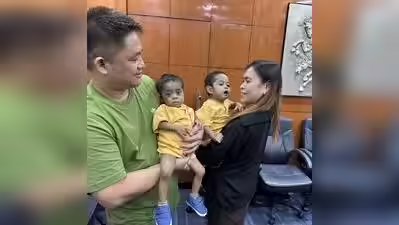
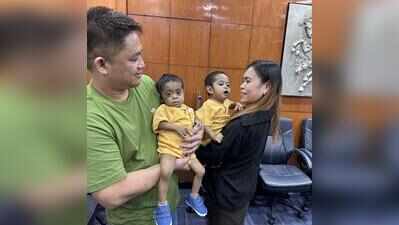
New Delhi: For nearly two years, every hospital visit left Kelly and Tyler’s parents with the same sinking feeling: that they were running out of time.The identical twins from Philippines were barely a few weeks old when both developed persistent jaundice. As months passed, they had to be repeatedly hospitalised because of gastrointestinal bleeding, swollen abdomens and poor growth. After that, unsuccessful surgeries back home left the parents searching for answers beyond their country’s borders.The search eventually brought them to Delhi.Last month, the 23-month-old twins underwent two complex living-donor liver transplants, performed a week apart at Indraprastha Apollo Hospital. Their mother donated part of her liver to one child, while their maternal uncle donated part of his to the other after their father was found medically unfit.Today, the brothers are recovering well, playing like healthy toddlers again and preparing to return home. A bright future now beckons, one their parents once feared would remain elusive.The twins were diagnosed with Choledochal Cyst Type IVA, a rare congenital disorder in which bile ducts inside and outside the liver become abnormally enlarged, blocking the flow of bile. Left untreated, the disease gradually destroys the liver, leading to cirrhosis and eventually liver failure.“The condition affects about one in 1 lakh children. Type IVA accounts for less than 10% of these cases. It is extraordinarily uncommon for identical twins to have the same rare subtype with both requiring liver transplant,” said Dr Anupam Sibal, group medical director and senior paediatric gastroenterologist at Apollo Hospitals.Unlike other forms of the disease, where a surgery can often correct the abnormality, Type IVA affects the bile ducts within the liver itself, making transplantation the only definitive treatment once liver failure develops.For the surgical team in Delhi, the challenge extended beyond performing two back-to-back paediatric liver transplants.“The twins were anatomically almost identical,” said Dr Neerav Goyal, senior consultant and head of liver transplant surgery. “Their CT scans mirrored each other, and when we operated on the second child, we encountered almost exactly the same anatomical problems we had seen in the first. That helped us during the second surgery, but the procedures remained extremely complex because the diseased bile ducts were densely stuck to surrounding organs, and the blood vessels required delicate reconstruction.”Each transplant lasted over 10 hours. Surgeons removed the children’s diseased livers before carefully implanting reduced portions of healthy donor livers, small enough to fit inside the abdomen of a toddler. One of the remarkable aspects of living-donor liver transplantation, doctors say, is the liver’s ability to regenerate, with both donor and recipient regaining most of the lost liver volume within months.“The health issues started when they were four months old and we hopped from one hospital to another. Later we went to a special hospital back home where they said transplant was the last hope, a process that’s not conducted in Philippines. That’s when we began exploring options,” said Daisy Ann, the mother. The parents got to know about options in India from other patients in the hospitals they were exploring.Doctors at Apollo Hospitals said the case is a reminder for parents not to ignore persistent jaundice or pale stools in infants. Early diagnosis, they said, can prevent irreversible liver damage and significantly improve outcomes.“Seeing both our boys smile again is something we used to pray for every day,” said Wilson, their father, adding that the treatment cost them between Rs 18 lakh and Rs 25 lakh for each child.“These boys were born together, fought together and have overcome together,” Dr Sibal said.