





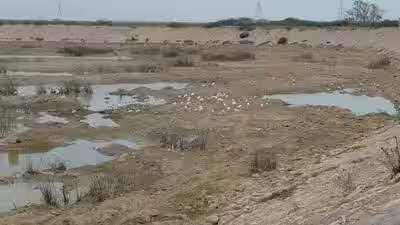
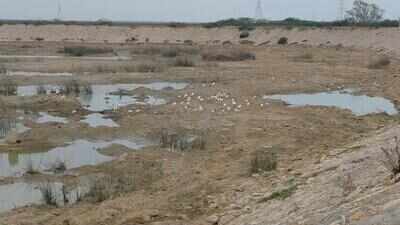
Rajkot: An acute water crisis has gripped Devbhumi Dwarka, the worst drought-affected district in Gujarat this year, forcing civic bodies to ration drinking water, with supplies being provided at intervals of seven to 15 days. The severe shortage has brought back grim memories of the droughts of the 1980s and 1990s, which residents had largely forgotten over the past two decades of consistent monsoons and the arrival of Narmada water.According to state govt figures, the district received just 139 mm of rainfall this monsoon against its seasonal average of 842 mm, leaving it with a staggering 84% deficit and just 16% of its normal rainfall. With local water reserves depleted, the district is now entirely dependent on Narmada water.In Dwarka and Okha, the crisis has intensified after their two primary water sources — Bhimgaja reservoir and Mayasar lake — dried up even before the official end of the monsoon.The temple town of Dwarka, which requires 5 million litres of water per day (MLD), now depends entirely on Narmada water supplied through the Gorinja sump. The facility also caters to Okha and rural areas of Dwarka taluka.“We are receiving irregular supplies that fall short of our requirements,” said C B Dudhiya, in-charge chief officer of Dwarka municipality. “We have taken up the matter with the state govt and are working to augment the Narmada water supply to the Gorinja sump to ensure adequate distribution.”Dwarka civic body is currently supplying water at intervals of 12 to 15 days. Inadequate pressure has also forced officials to deploy tankers to several neighbourhoods. Residents of Dwarka, Mithapur, Surajkaradi and Okha are increasingly depending on wells and private water tankers, paying between Rs 1,400 and Rs 1,700 for a 12,000-litre tanker.For residents relying exclusively on private water tankers, a single 5,000-litre tanker costs approximately Rs 800 and lasts a family of five to six just three days. Needing at least two tankers per week, households are forced to shell out nearly Rs 8,000 extra every month solely for water. In rural villages—where residents are already burdened by drought-induced debt—bearing this steep recurring expense has become nearly impossible.As the crisis deepens, local sources allege that some private tanker operators are illegally siphoning water from remaining water bodies and selling it at inflated rates. Furthermore, residents have raised concerns over the town’s more than 300 hotels, claiming that the hospitality sector—which relies on groundwater and private tankers to cater to tourists—is buying up available supplies at premium prices, leaving local households empty-handed.The situation in the district headquarters of Khambhaliya is marginally better, though still strained. Serving a population of two lakh, the town requires 8.5 MLD of water.“We are distributing water at four-day intervals,” said Girish Saraia, in-charge chief officer of the Khambhaliya Municipality. “The government is filling the Ghee dam with Narmada water under the SAUNI scheme.”The municipality draws 4 MLD from the Ghee dam and sources the remainder from old wells. While the civic body managed alternate-day distribution until peak summer, the failed monsoon forced it to stretch intervals to every four days.Civic officials across all urban bodies have expressed grave concern over the coming months, warning that the worst phase of the crisis lies ahead between Feb and July 2027.