









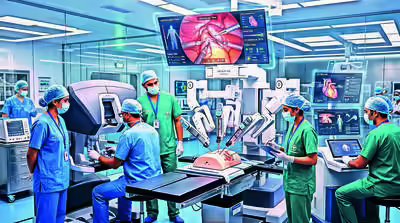
Pune: Doctors are increasingly turning to robotics to perform surgeries once thought impossible. By using robotic arms and high-definition optics to navigate tight cavities and execute ultra-precise manoeuvres, surgeons are significantly reducing complications and speeding up patient recovery.On National Doctors’ Day—observed every July 1st—many clinicians are declaring that these robotic systems have become their “new best friends” in the operating theatre.“From procedures once considered too risky to operations that allow patients to return home within days, robotic surgery is transforming cancer care across Maharashtra,” said Dr Ashish Pokharkar, head of the surgical oncology department at Noble Hospitals and Research Centre. “Over the last decade, robotic platforms have enabled surgeons to perform highly complex operations with greater precision, better vision, and enhanced dexterity, particularly in narrow spaces such as the pelvis, chest, and deep abdominal cavity.”One of the most significant shifts has been in the treatment of pelvic cancers, such as rectal cancer, where traditional surgery is often technically demanding due to limited space. “Robotic instruments with wrist-like movements allow for meticulous dissection. This improves the chances of complete tumor removal while preserving urinary and sexual function whenever oncologically appropriate,” Dr Pokharkar added.However, technology is not a replacement for human expertise. Dr Neeraj Rayate, bariatric surgery consultant at Jupiter Hospital, said a robot is an extension of the surgeon’s own hands. “The robot does not operate on its own; every movement is controlled by the surgeon. What the technology offers is superior precision, tremor filtration, and three-dimensional magnified vision. This allows us to perform complex surgeries with greater confidence while preserving vital nerves and blood vessels. Patients who previously required large incisions can now undergo complex procedures and resume normal activities significantly earlier.”Beyond oncology, robotics has led to remarkable progress in minimally invasive surgery for esophageal, gastric, and colorectal conditions. According to Dr Pokharkar, patients benefit from less postoperative pain, smaller incisions, reduced blood loss, and shorter hospital stays compared to traditional open surgery.The trend is not limited to major metropolitan hubs. Smaller centres and private hospitals are adopting robots for orthopaedics, neurosurgery, and urology, using these devices to improve implant accuracy and reduce recovery times for joint replacements.The shift is also bridging the gap between private and public healthcare. Pune’s Sassoon General Hospital (SGH) is a leading example of a govt institution embracing this change. Dr Lata Bhoir, head of the general surgery department at SGH, says, “The real success of robotic surgery is not just that it is high-tech; it’s that patients recover faster and experience fewer complications. For a govt hospital, every early discharge means one more bed available for another patient in need. Ultimately, technology must make healthcare safer and more patient-centered.”Experts believe the future of surgery extends beyond precision alone. Advances in artificial intelligence (AI), image-guided surgery, and remote connectivity are expected to further enhance surgical planning and safety.Further, as more indigenous companies enter the market, the cost of robotic surgery is expected to drop drastically, making it accessible to a wider population. Indian surgeons are already making their mark on the global stage; recently, an Indian team facilitated a landmark telesurgery event where French-based surgeons operated on patients in Indore using an indigenous robotic system. This successful demonstration of remote gastric bypass and cardiac repairs across continents signals a new era for Indian medical innovation.