







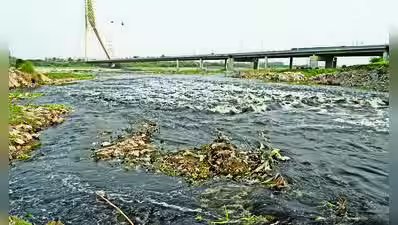
Noida: A high-powered committee appointed by Supreme Court has identified domestic sewage generated in the river’s catchment as its biggest polluter. The largest share of untreated sewage flowing into the river, according to the panel, comes from UP. Tasked with drawing up a comprehensive action plan on Yamuna, the committee recently submitted its report to the court and will give a presentation before judges on Oct 7.Headed by the Union home secretary, the six-member committee found that an estimated 7,999 million litres per day (MLD) of domestic sewage is generated in the Yamuna catchment across five states along its course – Uttarakhand, Himachal Pradesh, Haryana, Delhi and UP. Of this, 6,243.83 MLD is currently treated, leaving a treatment gap of around 22% (1,756 MLD is untreated).Across the Yamuna basin, 520 major drains empty into the river. UP’s treatment gap for sewage is 34% and for wastewater (non-sanitary effluent) is 63%.“The largest treatment gap exists in UP, followed by Haryana and Delhi. While substantial treatment infrastructure has already been created, many existing sewage treatment plants operate below installed capacity and large volumes of wastewater continue to enter the river through drains without interception or treatment,” the committee has pointed out.Supreme Court is hearing a petition filed by environmental activist Abhisht Kusum Gupta, who sought penalties against Noida for discharging untreated sewage into the Kondli drain that eventually meets Yamuna. During the hearing, the court decided to increase the ambit of the oversight and look at the entire stretch of Yamuna. On April 29 this year, it appointed advocate K Parameshwar as amicus curiae. The committee was formed on May 21.Industrial pollution remains concentrated in clusters. Around 6,300 water-polluting industries operate in the catchment. “Localised treatment gaps continue to exist, particularly in Haryana. Continuous monitoring systems and geo-tagging mechanisms have been adopted in most industrial clusters,” the committee said. It identified dairy waste as another major polluter of Yamuna.To address the issue, the committee has proposed investments of more than Rs 20,000 crore in sewage treatment infrastructure to reduce pollution loads, improve environmental flow, restore aquatic ecosystems and ultimately rejuvenate the river.“Timely execution of these interventions, supported by robust monitoring and inter-governmental coordination, will be critical to achieving the long-term objective of restoring the Yamuna as a clean, healthy and ecologically sustainable river system. For a focused approach and to avoid duplicity of efforts, it is necessary that all other litigations in the matter abate, and this case remain the sole monitoring mechanism,” the committee said.