











Buying a health insurance policy can take half an hour. Fighting a rejected claim can become a long ordeal. For a 69-year-old Surat man, it took 12 years. His battle began after he suffered an acute stroke in Manchester, UK, in 2009. His insurer initially approved cashless treatment there but later refused to pay, citing 15 years of undisclosed diabetes. He paid the 4,283-pound bill (about Rs 3.5 lakh) himself, and went to the Surat district consumer court and won. The insurer appealed before the state consumer commission and lost, then took the case to the national consumer commission. In 2021, the commission dismissed the insurer’s appeal as lacking merit, calling diabetes and hypertension lifestyle diseases.Across Gujarat, claims have been contested over undisclosed illnesses, hospitalisation, paperwork discrepancies, blacklisted hospitals and whether procedures were medical or cosmetic. Since 1989, Gujarat has recorded 3.3 lakh consumer cases, including 1.4 lakh insurance-related disputes across categories.Hospitalisation questionedIn Surat, a Class X student underwent surgery for perforated appendicitis during his board exams in 2020. His doctor allowed him to leave temporarily to take an exam. When his family filed a Rs 2 lakh claim, the insurer argued that if he could appear for an exam, he did not require hospitalisation. The consumer forum disagreed and ordered payment. “An oft-repeated reason given by insurers is that there was no need for the patient to be admitted. Sometimes they also question the number of days of admission, saying the stay was excessive,” said a doctor at a Vadodara hospital.He recalled a senior citizen admitted after a heart attack whose cashless treatment was held up by repeated queries. “Sometimes cashless approval is withdrawn or questioned at discharge, with fresh documents demanded and minor technical points raised. It becomes strenuous for patients and their families,” the doctor said.Vadodara consumer lawyer Hardik Shah says the problem becomes particularly difficult when treatment cannot wait. “In an emergency, families are concerned with getting the patient admitted. They are not in a position to first check whether the hospital is blacklisted, whether it has a minimum number of beds or whether some other technical condition may later be raised. Many of these issues come up only when the claim is processed,” Shah said.Advocate Rathin Raval, who practises before Gujarat High Court and consumer courts, said “hospitalisation unjustified” is a frequent ground for rejection. Claims may also be reduced under “reasonable and customary” clauses if hospital charges are deemed above prevailing rates. On blacklisted hospitals, Raval said, “Policyholders may not know a hospital is blacklisted. Consumer courts have come to the aid of insured persons in such cases because merely getting admitted to such a hospital may not be the patient’s fault,” Raval said.The illness you did not mentionMedical history is another major source of litigation. Two recent cases asked the same question: can an undisclosed condition justify rejecting a claim for unrelated treatment? In Ahmedabad, a pneumonia claim for an eight-year-old girl with Rett Syndrome was eventually allowed after doctors said the two were unrelated. In Surat, the insurer was similarly ordered to pay a cataract claim it had rejected over the non-disclosure of Parkinson’s disease after failing to establish a nexus between the two conditions.“The insurer’s perspective is that suppression by the insured is itself a ground for repudiation,” Raval said. “However, courts, including the Supreme Court in cases before it, have held that when the suppression has no nexus with the treatment claimed, the claim can become payable.” Insurers say the question of non-disclosure is more nuanced.Dr Vikas Gupta, head of the health administration team at Bajaj General Insurance, said waiting periods remain a common reason for rejection. “These include the initial waiting period, disease-specific waiting periods and the applicable waiting period for pre-existing diseases. Accidental injuries are generally covered without a waiting period,” Gupta said. Insurers also rely on accurate disclosure of conditions such as diabetes, hypertension, previous surgeries and other medical history while assessing a customer.Policybazaar’s head of health insurance, Siddharth Singhal, said simply having an undisclosed illness does not automatically justify rejecting an unrelated claim. “The circumstances and policy terms have to be considered,” he said. Gupta said even an apparently unrelated undisclosed condition could justify rejection if it was important to the insurer’s assessment when the policy was issued.The first point of disputeSome disputes begin at the point of sale. Agents TOI spoke to said customers do not always fill proposal forms themselves, and verification practices vary by insurer.Hemant Bhatt, an insurance agent, said, “If verification reveals a discrepancy, the customer may be offered revised terms, such as a higher premium or the same premium with a waiting period or restrictions on certain claims.”What gets explained at the point of sale can also vary. “To make it less complicated, we tell customers about the major exclusions, claim caps and waiting periods,” an agent said. “We mostly avoid talking about pre-existing diseases, thinking customers are unlikely to make a claim unless they are elderly.” He said barely half an hour may be spent briefing a customer on rules and disclosures. Agents and customers often take the policy seriously only when it comes to filing a claim. “Most customers are interested in the premium amount,” he said.In one Rajkot case, a swine-flu claim was denied for non-disclosure of diabetes and rheumatoid arthritis. The patient said she had informed the agent about it, but he said arthritis did not need to be disclosed. The consumer commission ordered payment, and the state consumer commission rejected the insurer’s appeal. Surat consumer lawyer Ishan Desai says disputes can also arise over the role played by third-party administrators, or TPAs, which process claims on behalf of insurers. “TPAs do not issue the policy, yet we have seen rejection communications on TPA letterheads,” he said, arguing that the final decision on repudiation or deductions rests with the insurer.Even accepted claims can leave policyholders with large bills because of sub-limits and deductions. Sunil Parekh, chairman of Consumer Education and Research Centre (CERC), said a policy carrying an overall cover of Rs 5 lakh or Rs 10 lakh can have much lower limits for particular procedures. “A policyholder may not realise there is a separate sub-limit until the claim is made,” he said.What sparks a deeper probeInsurers say deeper scrutiny is necessary in questionable claims. Gupta cited fabricated records, fictitious hospitalisation, impersonation, inflated or duplicate billing, upcoding, unbundling and unnecessary hospitalisation.“Early-duration claims can also trigger detailed verification, particularly where a serious illness is claimed soon after policy inception,” Singhal said.In one Vadodara case, an insurer rejected a Rs 58,953 claim for enteric fever treatment after an investigator used the patient’s phone GPS history to argue that he was not in hospital on the dates claimed. The insurer also alleged discrepancies in hospital records submitted with the claim. The consumer commission rejected the contention, observing that the phone could have been carried elsewhere by someone else, and ordered the insurer to pay the claim with 8% interest and costs.Gupta said digital trails such as Google Timeline, location history or social-media activity are not used for routine claim verification, but could be examined as corroborative evidence in suspected fraud cases. Singhal said such records are “not necessarily” used to verify claims.

Where health claims go wrong, in their own words
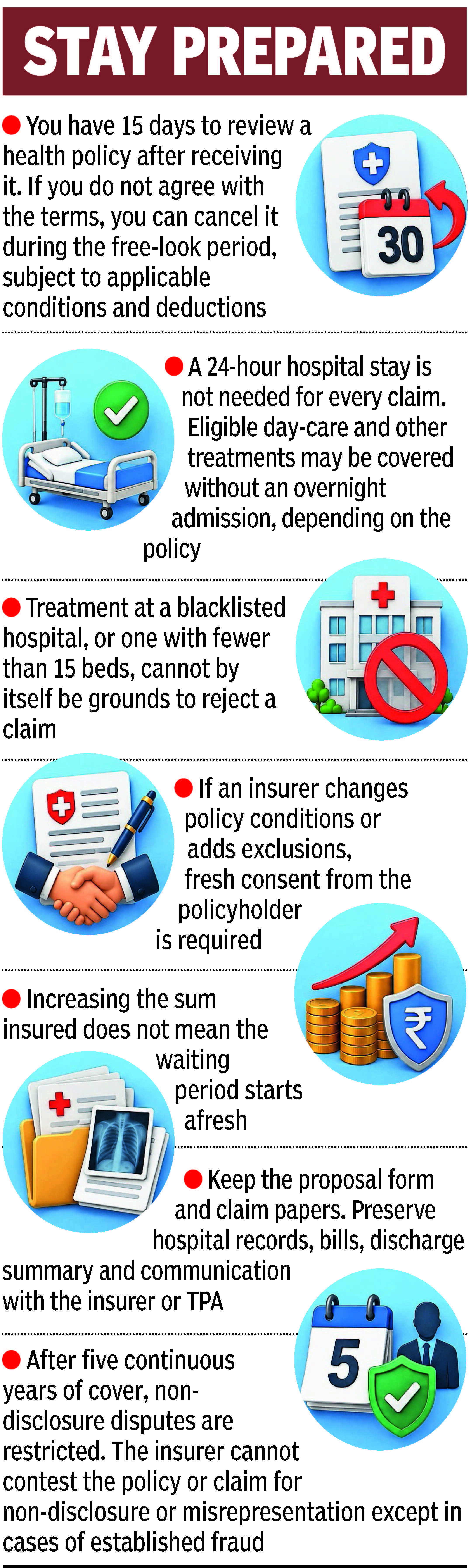
Cashless and reimbursement claims are governed by the same basic policy terms, insurers say, though scrutiny differs. Investigators may have about 24 to 48 hours for cashless cases and seven to 10 days for reimbursement claims. With reimbursement claims, the patient has already borne the hospital expense and must then chase the insurer for repayment.When the claim is rejectedThere is now also a five-year regulatory backstop to disputes over disclosure. Raval said the moratorium period, which was earlier eight years, has been reduced to five. “The insurer can repudiate a claim even after this period if fraud is detected. However, courts usually allow complaints by insured persons once the moratorium period is over,” he said.Raval said that even when a policyholder successfully challenges a rejection, an insurer does not face a separate penalty merely because it has lost similar cases before.
What policyholders ought to know
For rejected claims, Raval’s first advice is documentation. “Keep a copy of the entire file submitted to the insurer. Always truthfully declare pre-existing illnesses. It may increase the premium, but once an illness is properly declared, coverage may become available after the applicable waiting period,” Raval said. A policyholder can first approach the insurer’s grievance cell and, where appropriate, the insurance ombudsman or the consumer commission. The grievance process can also be used when a claim remains in limbo.Raval says there needs to be greater awareness of the ombudsman mechanism. He also points out that an insured person cannot be represented there by an advocate while the insurer is typically represented by an officer familiar with policy conditions. If the consumer does not succeed before the ombudsman, a consumer complaint can still be filed. For the policyholder, that can mean one more round after the medical crisis itself has passed.