







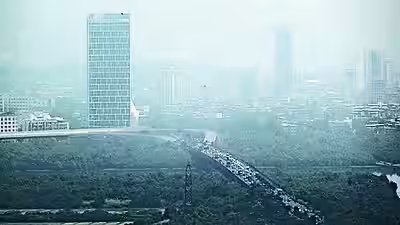
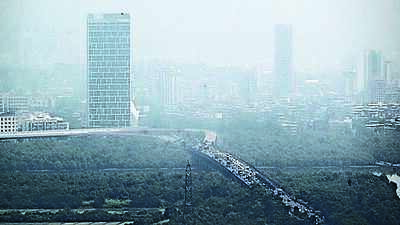
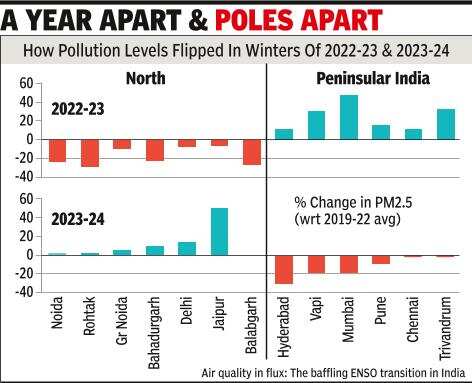
The winter of 2022-23 was remarkably clean in north India with PM2.5 levels down by up to 30% from the average of the previous three years, while peninsular India was considerably dirtier, with average PM2.5 levels in Mumbai spiking by 45%. The next winter (2023-24), the pattern dramatically reversed: PM2.5 spiralled in the North, while falling sharply in peninsular India.What changed within a span of a year? The big difference, as per a new study, was that 2022-23 was a La Niña year, while El Niño prevailed in the subsequent winter.Coming ahead of India’s peak pollution season, the paper, titled ‘Air quality in flux: The baffling ENSO transition in India’, published in Atmospheric Pollution Research journal Thursday, found that La Niña/El Niño conditions altered atmospheric circulation, PM2.5 transport pathways and weather conditions that determine whether pollution disperses or gets trapped.
Study traces how an El Niño changed the pollution map
That atmospheric conditions regulate pollution levels was always known. What the study shows is how the atmosphere in winters can behave very differently under El Nino and La Nina conditions, determining where pollutants accumulate and where they are carried away even when emissions remain broadly similar. However, the researchers caution that the study does not establish that El Niño invariably worsens air quality in Delhi or north India.“We are not implying that the 2023-24 El Niño pattern will be repeated this winter. The two years that we studied were unusual and unique,” said atmospheric scientist Gufran Beig, one of the study’s authors. “This year’s El Niño is likely to be the strongest on record.”The study found that during the La Niña winter of 2022-23, stronger winds over north India helped disperse emissions from stubble-burning and local sources. The altered circulation bypassed Delhi and its surroundings and transported these pollutants southwards towards peninsular India. This resulted in substantially higher PM2.5 levels in cities such as Mumbai and Thiruvananthapuram.The following winter, the atmospheric setup changed. Under El Niño, winds over northern India were weaker and passed through areas, including Delhi and Jaipur, rather than carrying pollutants away. The resulting stagnation favoured the accumulation of PM2.5. Jaipur, for instance, recorded an increase of about 50% compared with the 2019-22 average, while Delhi logged a spike of over 10%.Weather conditions also mattered differently in the two years. Rain can remove pollutants from air, while high pressure, weak winds and a shallow boundary layer can trap them close to the ground. In Jaipur, rainfall was more strongly associated with lower PM2.5 during 2022-23, whereas surface pressure became a more important factor during 2023-24, leading to pollution spikes after rain.The researchers also used backward air-mass trajectories to trace where the air reaching cities had travelled from. Jaipur continued to receive air from polluted northern regions during the El Niño winter. Hyderabad, by contrast, received more marine and southern air, helping explain why its pollution pattern moved in the opposite direction.
Share your thoughts in the comments
Be respectful · TOI community guidelines
Overall, the study found substantial year-to-year PM2.5 variations from average levels in 2019-22 — ranging from about a 40% decline to a 70% increase, despite no major changes in emissions or pollution-control policies during the period. The authors underlined that the correlations neither establish direct causation nor can these be extrapolated to other years.For Delhi-NCR, this has an important implication: relatively low local or agricultural emissions do not automatically guarantee cleaner air if large-scale circulation turns stagnant. Conversely, even substantial emissions can have a smaller local impact when strong winds efficiently disperse or divert them.The winter pollution story may begin in Delhi and its neighbourhood, but increasingly, the weather that decides its intensity is being written on a much larger canvas.