









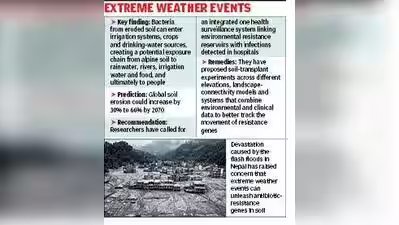
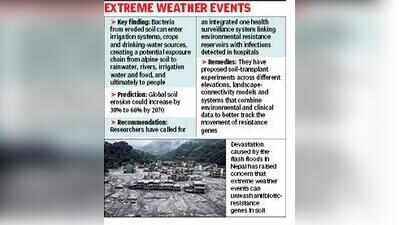
Kolkata: A recent study conducted by a team of researchers at Imperial College London has found that bacterial diversity has declined by 15% to 30% in areas that have suffered erosion caused by calamities across the world.The study, led by Bengal’s Arnab Majumdar, a professor of Imperial College London, claims that strains of bacteria, carrying antibiotic resistance genes, thrived at places, where the eroded soil accumulated.The study gains significance in the backdrop of the recent flash floods in Nepal. The study also estimates that global soil erosion could increase by 30%-66% by 2070.The devastation caused by the flash floods and landslides in Nepal has raised the concern that extreme weather events can unleash and redistribute antibiotic-resistance genes in soil.The study has cautioned that climate-driven soil erosion, landslides and flooding can transport the antibiotic resistance genes from remote mountain environments into rivers, agricultural fields and human settlements. The research finding has been published in “Journal of Hazardous Materials”. The study was led by Majumdar of Imperial College London’s Department of Life Sciences, along with David R Johnson of Swiss Federal Institute of Aquatic Science and Technology (Eawag) and Stefan Kolb of Leibniz Centre for Agricultural Landscape Research (ZALF), Germany.“Our concern stems from the role of topsoil as a reservoir of microbes. During intense erosion, microbe-rich soil can be washed into rivers and low-lying areas. Where heavy metals are present, they can contribute to the co-selection of antibiotic-resistance genes,” Majumdar said. Flood waters can provide a direct pathway for environmental resistance genes to reach humans.Bacteria from eroded soil can enter irrigation systems, crops and drinking-water sources, creating a potential exposure chain from alpine soil to rainwater, rivers, irrigation water and food, and then to people. The researchers also warned that resistance-gene-carrying bacteria can travel hundreds or even thousands of kilometres through airborne dust.Adding to the concern, clinically significant resistance genes have been detected in clouds and water bodies in remote high-mountain regions.According to the researchers, this indicates that antibiotic resistance can travel considerable distances through atmospheric and environmental pathways, even in areas with limited direct human activity. Considering the possibilities of increase in global soil erosion, the researchers have called for an integrated One Health surveillance system linking environmental resistance reservoirs with infections detected in hospitals. They have proposed soil-transplant experiments across different elevations, landscape-connectivity models and systems that combine environmental and clinical data to better track the movement of resistance genes.