









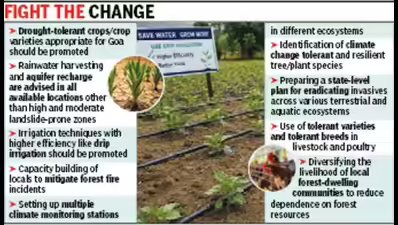
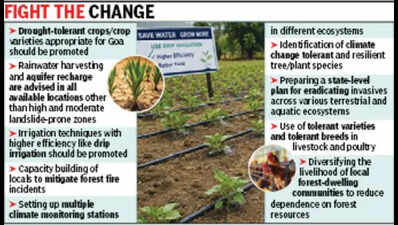
Gauree.Malkarnekar@timesofindia.comPanaji: As Goa marks World Environment Day on June 5, the state stands out as the only one in India with a comprehensive policy framework in place to tackle climate change. Alongside an approved State Action Plan on Climate Change and a Clean Energy Roadmap, the Goa State Biodiversity Strategy and Action Plan is in the final stages of govt approval. Yet, experts caution that the real challenge lies in translating these policies into action.The warning comes at a critical time. The draft Goa State Biodiversity Strategy and Action Plan says that unless greenhouse gas emissions are curbed, temperatures in Goa could routinely touch 40°C by 2040.According to the report’s climate change sub-committee, Goa is warming faster than the national average. Mean temperatures in the state have risen by about 1°C between 1901 and 2018, with most of the increase occurring after the 1970s.The report was prepared by Rajiv Kumar Chaturvedi, faculty member at BITS Pilani Goa Campus and a UN expert on greenhouse gas emissions inventories, and Sushant Suresh Naik, principal scientist at CSIR-National Institute of Oceanography (NIO), who has more than two decades of research experience at CSIR-NIO and the National Centre for Polar and Ocean Research (NCPOR).The experts outline starkly different futures depending on global emissions levels. If atmospheric carbon dioxide concentrations rise to 940 parts per million (ppm) by 2100, Goa could see temperatures increase by as much as 4.5°C. However, if emissions are controlled and CO2 levels are limited to 538ppm, the projected rise would be about 2.5°C compared to the 1901-1950 baseline.“Extreme temperatures are projected to increase under climate change scenarios. By 2040, maximum temperatures of 40°C or more are expected to become commonplace in Goa. Minimum temperatures are also projected to rise by 3°C to 7°C,” the report states.The report also warns that Goa is likely to face more frequent and intense climate extremes, including droughts, cyclones, floods and unseasonal rainfall. Such events could disrupt livelihoods, reduce agricultural yields and deepen distress in farming communities.To reduce climate risks, the experts have recommended a range of adaptation measures, including the development of climate-resilient agricultural systems, mapping forest fire-prone areas, strengthening early warning systems for extreme weather events, and identifying and protecting ecologically critical habitats.Fight The Change* Drought-tolerant crops/crop varieties appropriate for Goa should be promoted* Rainwater harvesting and aquifer recharge are advised in all available locations other than high and moderate landslide-prone zones* Irrigation techniques with higher efficiency like drip irrigation should be promoted* Capacity building of locals to mitigate forest fire incidents* Setting up multiple climate monitoring stations in different ecosystems* Identification of climate change tolerant and resilient tree/plant species* Preparing a state-level plan for eradicating invasives across various terrestrial and aquatic ecosystems* Use of tolerant varieties and tolerant breeds in livestock and poultry* Diversifying the livelihood of local forest-dwelling communities to reduce dependence on forest resources