










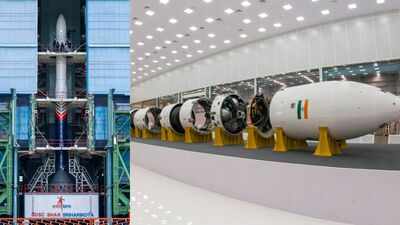
HYDERABAD: India’s first privately built orbital rocket, Vikram-1, developed by Hyderabad-based Skyroot Aerospace, is all set for blastoff,with the launch window of July 12 to Aug 4, 2026, finally being declared for `Mission Aagaman’. Aagaman, which means arrival in Sanskrit, is aimed at declaring to the world India’s private orbital launch capabilities, the spacetech startup said on Thursday.Skyroot Aerospace said its maiden orbital test flight will lift off from the first launch pad of Satish Dhawan Space Centre-SHAR in Sriharikota, subject to completion of assembly and testing at the launch site, as well as weather, safety and range clearances.The Hyderabad-based company said all stages of Vikram-1 have been integrated and stacked at the launch pad. The test flight’s primary objective is to gather real-time flight data across propulsion, stage separation, guidance, navigation, control and overall vehicle performance.“The single most important objective of Mission Aagaman is to capture the real in-flight performance data from every system on Vikram-1,” said Pawan Kumar Chandana, co-founder and CEO of Skyroot Aerospace.“This data cannot be fully replicated through ground testing. It will help us validate our designs and inform subsequent vehicle development as we build a reliable, high-cadence commercial launch programme.”Vikram-1 is a seven-storey, multistage orbital launch vehicle built with an all-carbon composite structure. It uses in-house-developed propulsion systems, including 3D-printed engines and high-thrust solid-fuel boosters.The rocket is designed to carry small satellites weighing up to 350 kg to low Earth orbit. Its maiden mission will target an orbit at an altitude of 450 km with a 60-degree inclination.Mission Aagaman will be Skyroot’s second flight after Vikram-S, a suborbital rocket that became the first privately built rocket to reach space from Indian soil on Nov 18, 2022.The company said the upcoming launch will be partially commercial, carrying a mix of domestic and international customer payloads. Full commercial flights are expected after one or two successful orbital demonstrations.“With Vikram-S in 2022, we validated the foundation of our technology stack; with Vikram-1, we take our biggest step yet toward a reliable, high-cadence launch programme built in India, for India and the world,” said Naga Bharath Daka, co-founder and chief operating officer of Skyroot Aerospace.The flight-ready Vikram-1 rocket was unveiled by Prime Minister Narendra Modi in Nov 2025 during the inauguration of Skyroot’s Infinity campus.Skyroot said its latest mission reflects India’s growing private space capabilities, supported by the Indian National Space Promotion and Authorisation Centre and the technical infrastructure of the Indian Space Research Organisation. The company is positioning its “Cab to Space” model as a dedicated launch service for small satellite operators seeking precise and frequent access to orbit.India’s space economy is projected to grow from about $8.4 billion to $44 billion by 2033, with indigenous launch capability expected to play a key role in expanding the country’s private space ecosystem.Founded by Chandana and Daka in 2018, Skyroot is developing the Vikram series of launch vehicles for small satellite operators. The company, which recently became a unicorn with a valuation of more than $1.1 billion, is backed by investors including GIC, Temasek, Sherpalo Ventures and funds managed by BlackRock.